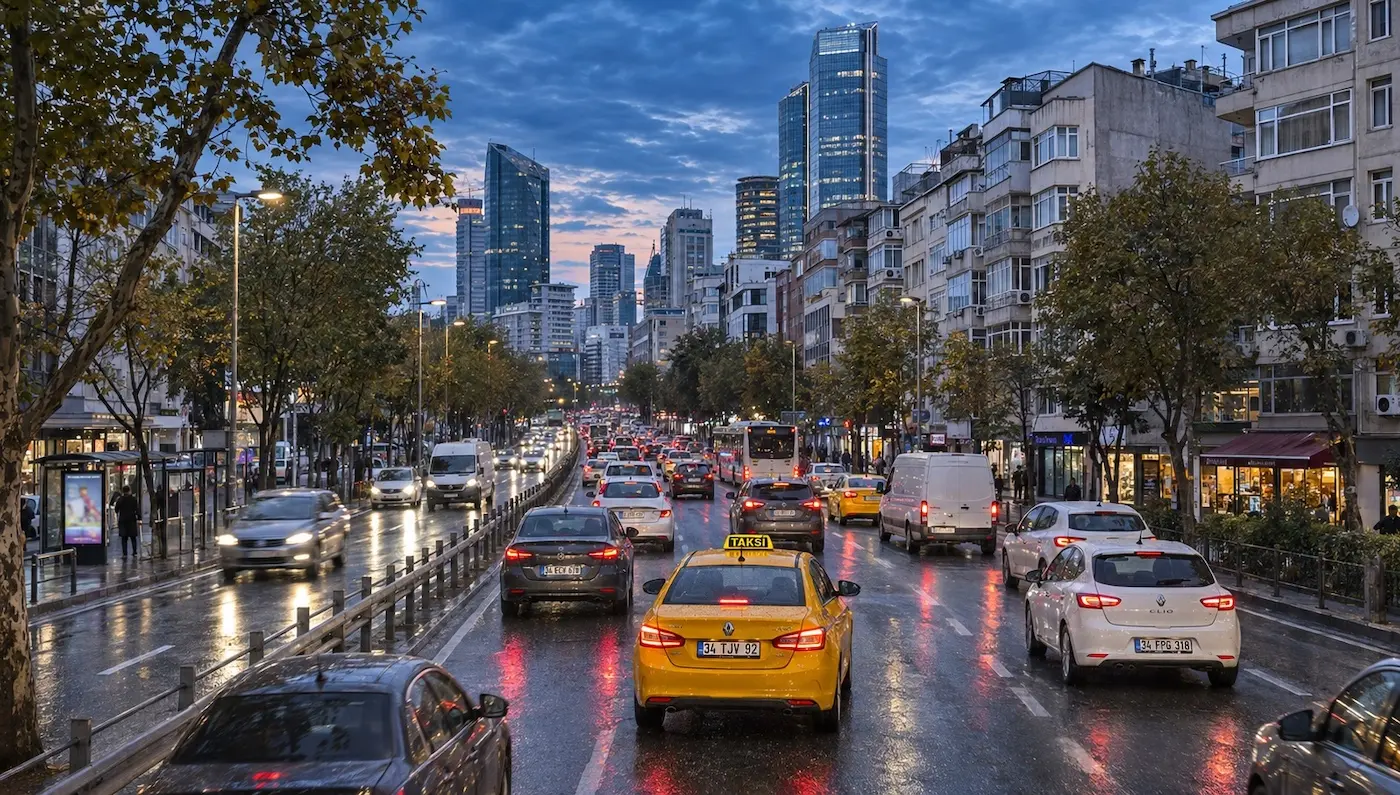
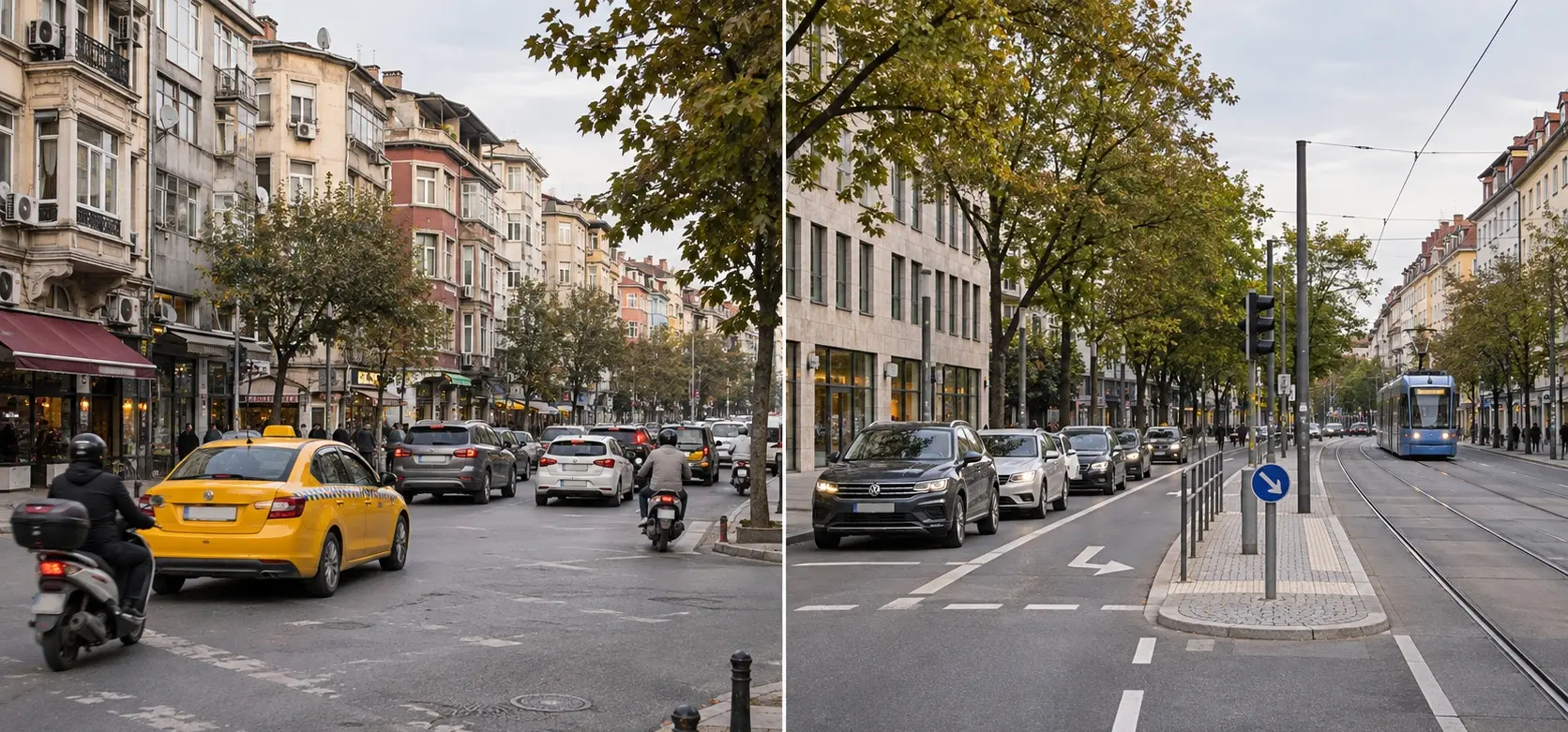
Stand at a busy junction in Istanbul for five minutes. You will hear horns and see scooters squeezing through gaps that are not really there. A taxi driver has invented a third lane. Now picture the same junction in Munich: neat, quiet, and almost boring.
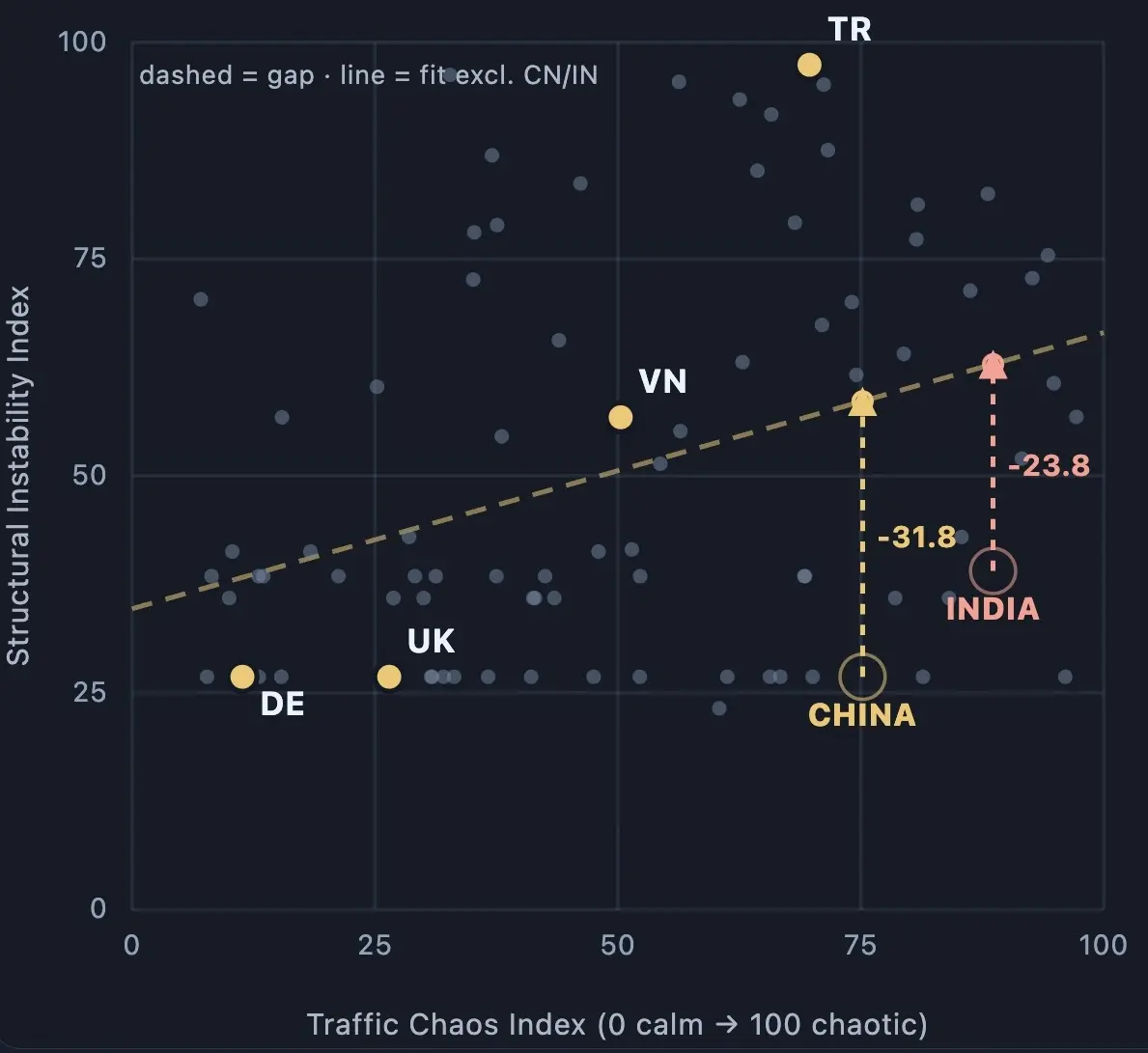
An analysis covering 90 countries looked at traffic chaos alongside 30 years of monetary instability, from 1996 to 2025. It counted years when inflation exceeded 10%, interest rates moved by more than five percentage points, or currencies depreciated by more than 20%. Turkey scored 69.7 for traffic chaos and 97.4 for monetary instability, the highest instability score in the sample. Germany scored 11.4 on traffic and 26.8 on economic swings.
Plot every country on one chart and a pattern appears: countries with more chaotic roads tend to have bumpier economies. The link is real: a correlation of +0.33. So, should economists swap their spreadsheets for a seat in a taxi?
Traffic chaos against economic unpredictability across 90 countries. Turkey sits at the top, Germany near the bottom left, and China and India sit well below where their traffic would predict.
Wealth Explains the Link Between Traffic and Economic Stability
The link is real, but it mostly comes down to wealth. Richer countries have better roads, stricter enforcement, and calmer drivers. They also tend to have steadier economies. Compare countries at the same income level and the link almost disappears: the correlation falls to +0.03.
Traffic does not cause economic swings, and it cannot predict them. What it mostly shows is how rich a country is. That is worth remembering whenever someone shows you a neat pattern and calls it proof.
Why China and India Defy the Pattern
Then there are China and India. Their roads are as chaotic as almost any on the chart, yet their economies are far steadier than the pattern suggests. The analysis points to what is going on behind the scenes:
- China: State-controlled banks, capital controls, and high domestic savings provide potential explanations for its relative monetary stability.
- India: Public banks, a managed currency, and a large domestic consumer market offer a different set of buffers.
- Both: Relatively low external debt may reduce exposure to international financing shocks.
These are plausible explanations, rather than causes proven by the analysis. A chaotic street can sit on top of a tightly managed financial system. The surface does not always show the structure underneath.
For property investors, the useful lesson is to look beneath first impressions. Busy roads tell you little about the direction of house prices. Borrowing costs, household savings, and the purchasing power of local buyers give you a more useful starting point.
What Turkey’s Economic Swings Mean for Property Investors
This is where it gets interesting for anyone with money to invest. An unpredictable economy is not a broken one. It swings, and swings cut both ways. People caught on the wrong side can lose a lot. People who are already in position when the market turns can gain a lot. A calm, predictable economy rarely gives you either. Turkey regularly gives you both.
The analysis records 18 years in which Turkey’s annual inflation exceeded 10% between 1996 and 2025. Live through enough inflation cycles and you stop trusting cash. Turkish households worked this out generations ago. Instead of holding cash, they keep their wealth in things that hold value: property and gold.
The Presidency's Finance Office surveyed more than 1,500 households. Real estate came top for investor satisfaction at 81%. Gold came next at 76%, ahead of Lira deposits (72%) and foreign currency (71%). An appraisal executive summed it up: Turks see housing as a defence against inflation.
This is important because Turks make up more than 95% of property transactions in their own country. The market moves when local money moves.
High Deposit Rates Keep Turkish Savings on the Sidelines
Right now, a lot of that local money is waiting. In May 2023, Turkey dropped its low-interest policy. Within months, rates climbed from around 8% to 10% to as high as 55%. Suddenly a bank deposit paid well, and a mortgage cost a fortune. So, families did the sensible thing. They parked their money, collected the interest, and waited.
That money has piled up. Turkish residents hold more than $1 trillion USD in bank deposits. Wealthy cash buyers still bought about 1.6 million homes in 2025, a record, even with rates high. In 2026, though, buying with credit remains weak, and real prices are down 6.5% year-on-year.
For now, most of that money is still in the bank.
Falling Interest Rates Could Bring Local Buyers Back
On 22 October 2026, the Central Bank cut its policy rate from 37% to 36%. It is a small step, but the signal is there. As rates fall, keeping money in the bank pays less each time a deposit renews. And a culture that has always trusted bricks over cash knows where that money goes next.
We have seen this before. Turkish property tends to move in cycles of around seven to eight years. From 2015 to mid-2023, prices increased by roughly 20% a year, even after allowing for currency swings.
Our Projection: When local money returns in force, the first years of the next cycle could be the strongest, and investors already in place stand to benefit most. That is a projection, not a guarantee. Cycles do not follow a timetable.
Why International Cash Buyers Have a Window to Negotiate
Today, borrowing is still expensive, few local buyers are competing and motivated sellers are negotiating. That puts international cash buyers in a rare position. They have a window to secure the best deals before domestic buyers come back in greater numbers.
Most investors wait until everyone else is buying. A few move early, while the choice is wide and prices are soft. Unpredictable markets pay the people who move early, not the ones who arrive with the crowd.
Currency Risk and Due Diligence When Buying: The risks have not gone away. A weaker Lira can wipe out Lira gains once you convert them to Dollars, and rules can change. Buy the asset, not the headline, and insist on independent legal and valuation checks before you commit.
Buying Before Domestic Demand Strengthens
Istanbul's traffic will not tell you where the economy is heading. A neat pattern is not proof. But it does remind you what kind of place you are in: fast, noisy, and unpredictable, a place that rewards people who understand it.
Turks understand it. They have been holding back for years, and the money is still waiting. The question is whether you will already be in position when it moves.
Cameron Deggin is Founder and CEO of Property Turkey. A former finance professional and FCCA-qualified accountant, he founded the company in 2001 after recognising Turkey’s investment potential. With more than two decades analysing Turkish real estate, Cameron regularly advises international investors and is quoted by media including the Financial Times and BBC.




 By:


 Founder & CEO, Property Turkey
 Bodrum
 4
 4














 X