Key Takeaways: Why Cash Buyers Hold the Cards in Istanbul
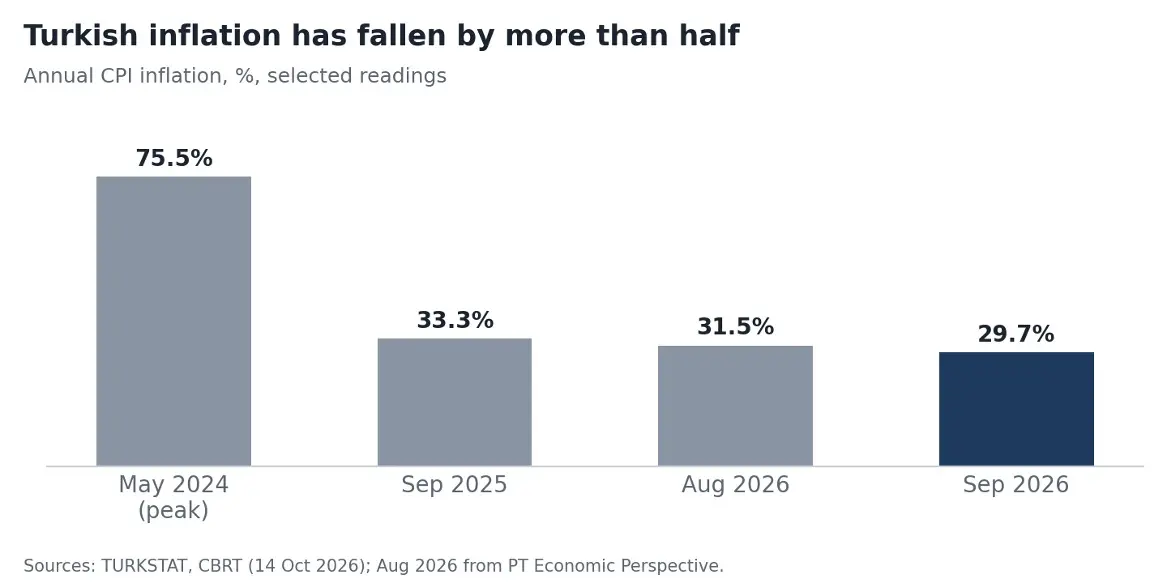
- Inflation has fallen from 75.5% in May 2024 to 29.7% in September 2026. The Central Bank (CBRT) says it will keep policy tight, with the rate at 37%.
- High borrowing costs and weak domestic demand favour cash buyers. House sales fell 14.7% year on year in August, and only 17.4% of sales used a mortgage.
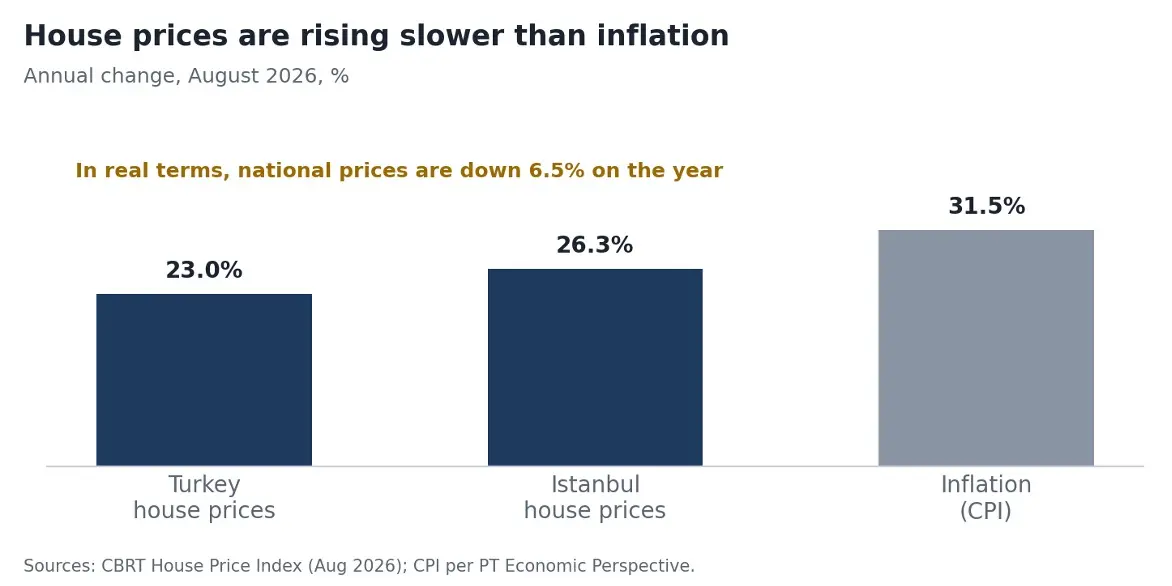
- House prices are rising slower than inflation: national prices are down 6.5% in real terms, and Istanbul is down roughly 4%.
For a cash buyer with a multi-year horizon, our answer is yes, with conditions. The macro picture has improved, and the price picture has softened. Annual inflation was 29.7% in September 2026, against 33.3% a year earlier and a peak of 75.5% in May 2024. Services inflation is at its lowest monthly pace in five years, and the Central Bank's own measure of underlying inflation has slowed to about 24% annualised.
The Central Bank has also been clear about what comes next. In his 14 October presentation, Governor Fatih Karahan said policy will stay tight until price stability is secured, and that rates will be raised again if the outlook worsens. That is a signal of discipline, not of imminent cuts.
Chart 1. Annual CPI inflation, selected readings. Sources: TURKSTAT, CBRT presentation 14 Oct 2026; August 2026 figure consistent with the CBRT house price index real-change calculation.
Why Do High Interest Rates Favour Cash Buyers?
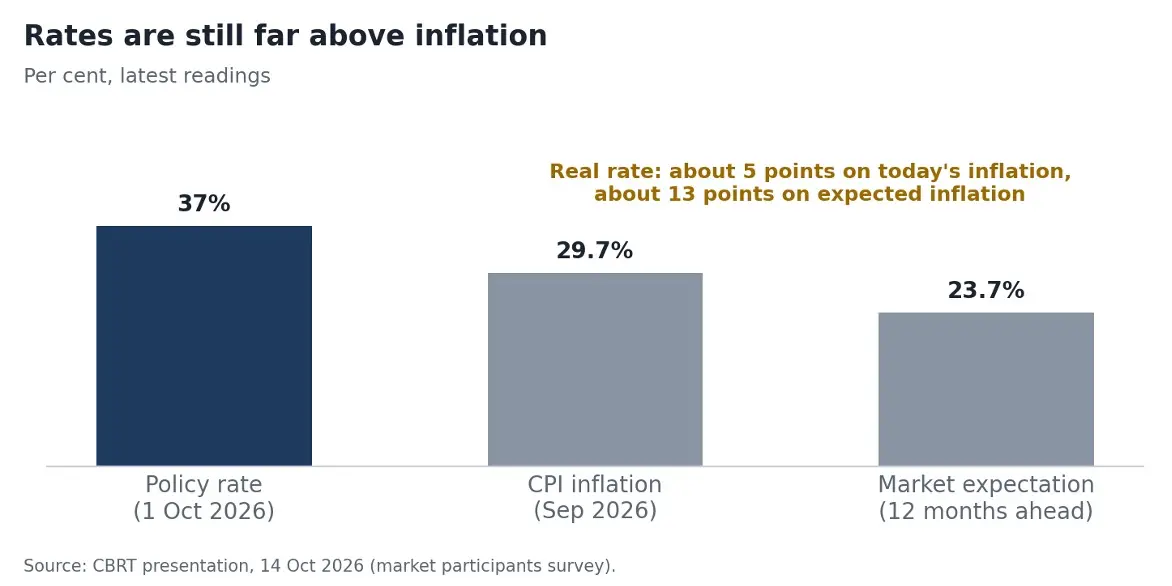
The policy rate is 37%. With inflation at 29.7%, that is a real rate of about 5 points. Against the 23.7% inflation that market participants expect over the next 12 months, the real rate is about 13 points. Money is expensive for anyone who has to borrow it.
Chart 2. Sources: CBRT presentation, 14 Oct 2026. Policy rate as of 1 October 2026.
That shows up in the housing data. TÜİK reported 127,410 home sales in August 2026, a fall of 14.7% on a year earlier. Second-hand sales fell 19.4%. Mortgaged sales rose 7.2% to 22,131, from a low base and, in our view, as borrowing costs ease from last year's levels, but they were still only 17.4% of the total. In practice, most purchases are cash purchases, and local demand is subdued.
Table 1. Cash Buyer Versus the Mortgage-dependent Market
Indicator (August 2026)
Reading
What it Means for a Cash Buyer
Total home sales
127,410 (-14.7% y/y)
Weaker local demand, more room to negotiate
Second-hand sales
83,032 (-19.4% y/y)
Resale sellers face the thinnest demand
Mortgaged sales
22,131 (17.4% share, +7.2% y/y)
Credit is a small slice of the market, and a 37% policy rate keeps it costly
Sales to foreigners
1,938 (+0.1% y/y)
Foreign demand is steady, not crowded: 1.5% of all sales
House prices, real terms
-6.5% y/y (9th month of decline)
Prices are not keeping pace with inflation
Sources: TÜİK (August 2026 housing sales), CBRT House Price Index (August 2026). Foreign buyers are led by Russians (343), Ukrainians (147) and Iranians (140).
Both, depending on the yardstick. In Lira, the Central Bank's house price index rose 23% in the year to August, and Istanbul rose 26.3%. But consumer prices rose about 31.5% over the same period. In real terms, national prices fell 6.5%, the ninth consecutive monthly real decline, and Istanbul fell roughly 4% by our calculation.
Chart 3. Sources: CBRT House Price Index, August 2026; Istanbul real change is our calculation.
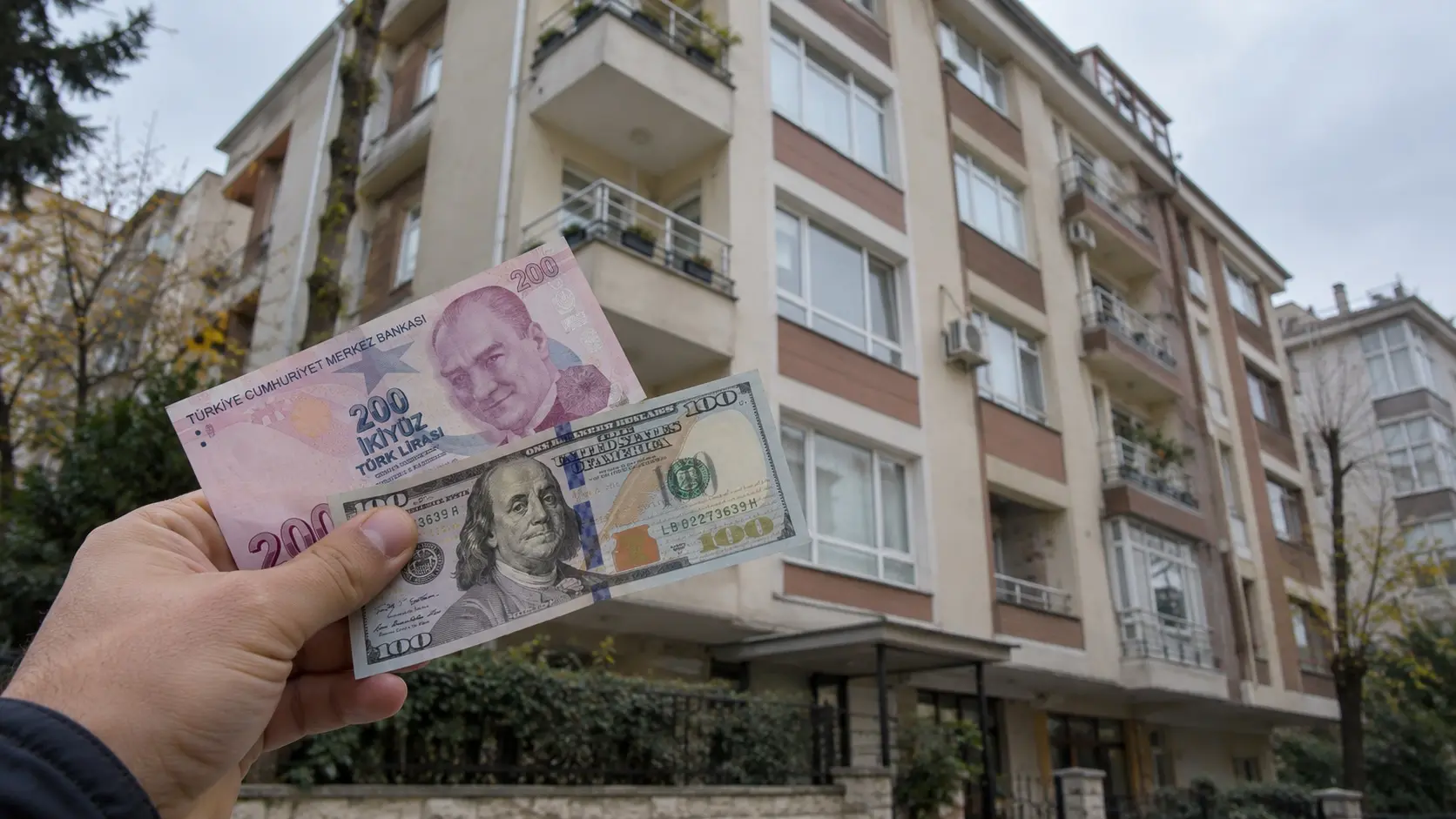
For a buyer, a market where prices lag inflation is an entry point, not a warning. The risk is the currency. The Lira ended September at about 49.0 to the Dollar, and buyers should judge any purchase in Dollars and Euros, not only in Lira.
What is Happening to Rents and Rental Yields?
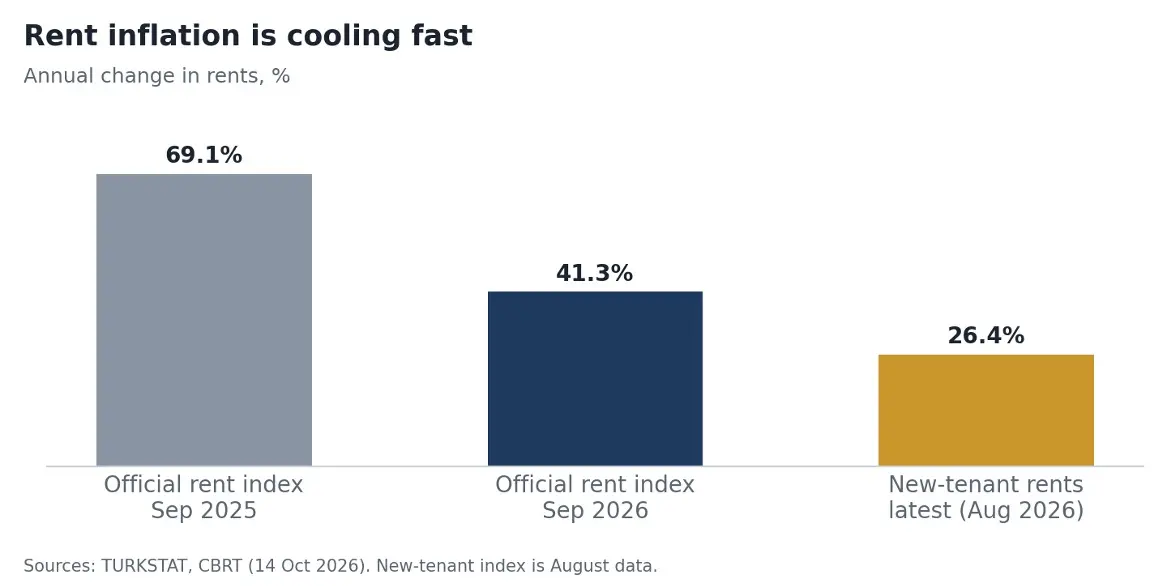
Rents are the part of the economy that most affects landlords. Annual rent inflation in the official index fell from 69.1% in September 2025 to 41.3% in September 2026. The Central Bank's new-tenant rent index, which leads the official figure, shows 26.4%.
Chart 4. Sources: TURKSTAT, CBRT presentation 14 Oct 2026. New-tenant data is for August 2026.
Our Reading: Rent growth is normalising. Landlords should plan for slower rent rises, which means buying at a sensible entry price is more important than before.
How does Turkish Citizenship by Investment Fit in?
The citizenship route is the clearest link between a property purchase and a long-term plan. A foreign investor can apply for Turkish citizenship by buying real estate worth at least $400,000 USD, either as one property or several combined. The property needs a licensed valuation report from an SPK-authorised appraiser, clean Title Deed, and must be held for three years. The $400,000 USD figure excludes purchase costs.
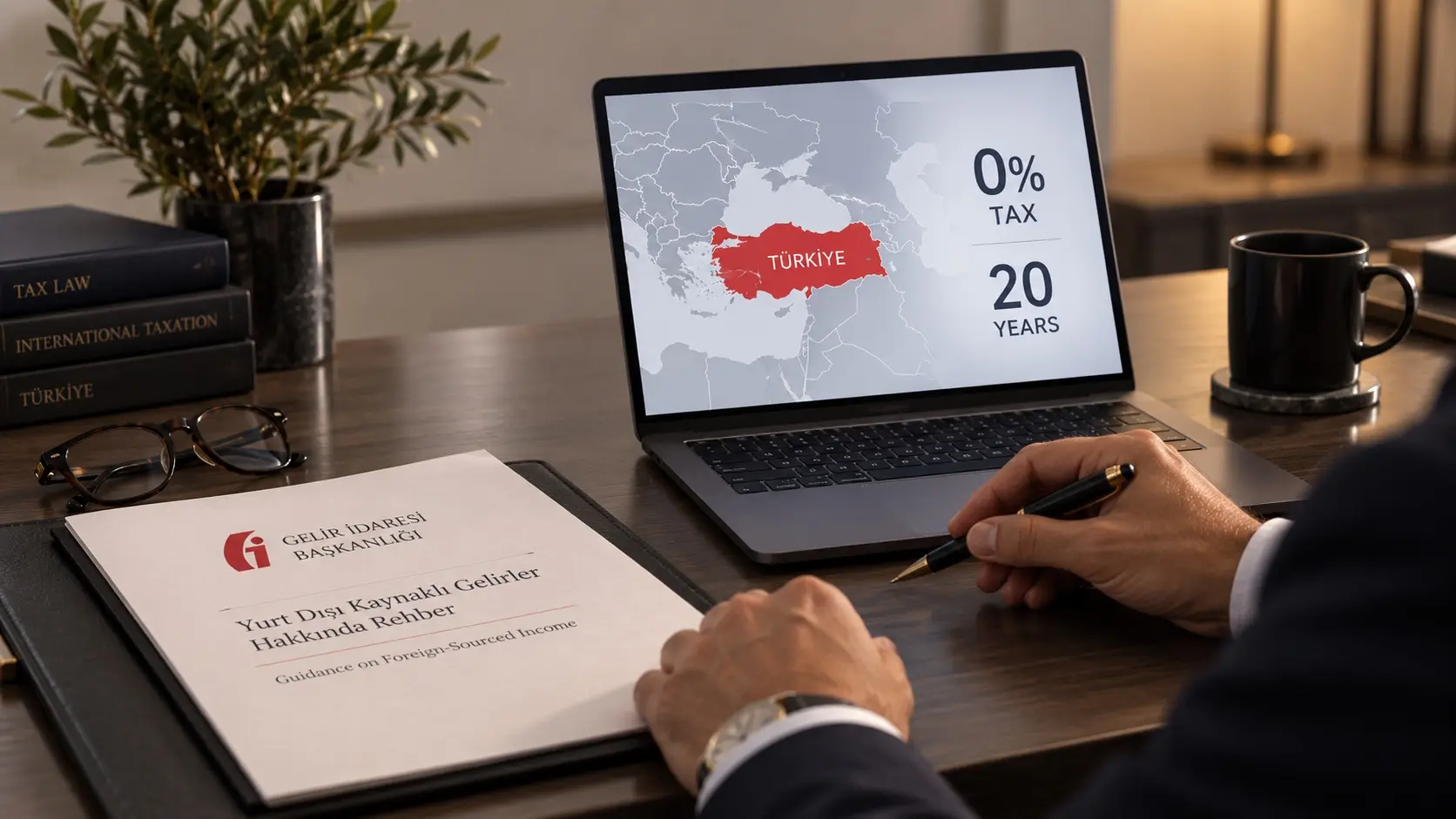
This is the second half of the “two birds, one stone” argument. Law No. 7582, published in the Official Gazette on 4 June 2026, introduced a new Article 20/D. It exempts income and gains earned abroad for 20 years for individuals who become Turkish tax residents on or after 1 January 2026, provided they had no Turkish residence or tax liability in the three calendar years before. Inheritance passing on death during the period is taxed at a reduced 1% rate.
Table 2. Two Routes, Two Different Tests
Citizenship by Investment
20-year Foreign Income Exemption
What it is
Turkish passport through a qualifying investment
Income tax exemption on foreign-source income and gains
Entry test
At least $400,000 USD in real estate, held 3 years
Become a Turkish tax resident from 1 Jan 2026, with no Turkish residence or tax liability in the prior 3 years
Duration
Permanent once granted
20 years
Not covered
Purchase costs; the property cannot be sold within 3 years
Turkish-source income, such as rent from a Turkish flat; no credit for foreign tax paid
Key trap
Valuation and Title Deed must be clean
Citizenship is not tax residence. They are separate tests
Sources: Law No. 7582 as reported by EY and IMI Daily; SPK valuation rules as summarised by Global Citizen Solutions. Confirm with a licensed adviser.
Note the trap. A passport does not make you a tax resident. The key distinction is between holding a Turkish Residence Permit and being considered resident in Turkey for tax purposes, which is generally based on living in Turkey for more than six months in a calendar year. Taking tax advice before you move is essential.
Table 3. Does a Past Turkish Residence Permit Disqualify You?
Previous Situation
Likely Outcome
Held a Residence Permit but lived abroad
May qualify
Held a permit and maintained a legal domicile in Turkey
Risk of disqualification
Lived in Turkey for more than six months in a relevant year
Generally disqualifying
Owned Turkish property while living abroad
Not automatically disqualifying
Had a Residence Permit more than three calendar years ago
Generally not an obstacle by itself
Source: Property Turkey. General guide only. Each case depends on its facts, so confirm with a licensed tax adviser.
Why is Affordable Central Istanbul the Best-value Zone?
Istanbul has about 15.75 million residents, 18.3% of Turkey's population (TÜİK 2025), and it leads foreign purchases year after year. In our view the best value sits in the affordable central belt rather than at the luxury end or the far suburbs. Suburban Istanbul has huge amounts of pre-zoned land, while the centre has hardly any. Property Turkey's records bear this out: since 2001, across more than 3,000 clients, suburban stock has taken on average about three times longer to sell than central stock. That is demand and supply showing up in the data.
Property Turkey's own portfolio shows why. Across six central districts, the median asking price per m² for new buildings runs from about $3,200 USD to about $7,400 USD, so a $400,000 USD budget buys a very different home depending on the district.
Table 4. Istanbul Apartment Asking Prices by District (USD), Property Turkey Portfolio
Source: Property Turkey portfolio data extracted 15 October 2026, 336 listings across six districts. Asking prices for new buildings, predominantly built in the last 10 years; pre-2002 non-compliant stock is excluded. Gross sizes. Not transaction prices. Floor areas are our arithmetic: $400,000 USD divided by the median price per m².
Kağıthane has the lowest median at $3,192 USD per m², and $400,000 USD buys about 125 m² there, more than double the roughly 54 m² it buys in Beşiktaş. Beyoğlu, at $3,764 USD, is only about 18% dearer than Kağıthane, and Kadıköy about 12%, while Şişli is 42% and Sarıyer 57% above. The affordable central belt of Kağıthane, Kadıköy, and Beyoğlu offers the most space and the most city for the money. Kağıthane also has the M11 metro linking it to the airport in about 25 minutes. One caution: some analysts say early investors in Kağıthane have already captured part of the upside, so entry price and building quality are important.
Yields are a different story. Property Turkey manages more than 1,000 properties in central Istanbul, mainly in these districts. Across that managed portfolio, owners achieve on average 5.5% to 6% net on long-term rentals and around 7% to 8% net on Airbnb-style short lets, after our fees and taxes. Yields vary much less between these districts than prices do, so the cheaper central areas give up little income and buy considerably more space. These are averages, not guarantees.
How Does Urban Regeneration Change Central Istanbul?
Istanbul sits on an active earthquake zone, and the state has been replacing old buildings at scale since 2012. According to the minister responsible, about 1.007 million units out of 1.298 million included in transformation projects were complete by August 2026, with around 291,000 still in progress. The “Half on Us” (Yarısı Bizden) programme has enrolled 384,553 units, with homeowner support of up to 1.875 million Turkish Lira for building-based projects.
For investors, regeneration does two things. It replaces ageing stock in central districts with safer, modern buildings, and it removes older supply from the market while projects are built. In our view, both support values in the areas where it is concentrated. Şişli's Bomonti district is the example often cited: after its transformation, per-m² prices roughly doubled, and in Kağıthane towers are replacing 1970s walk-ups as industrial zoning gives way to residential use. Check the specific building: its permit status, zoning, and the status of any transformation decision are all important.
What Does it Cost to Buy Property in Istanbul?
Budget for Title Deed tax (often called stamp duty) of generally 4% of the declared value. In Urban Regeneration projects it can be as low as 0%, which is one more reason regeneration areas deserve a look. Other costs, such as notary fees, survey fees, and similar charges, typically add up to around $1,000 USD in our experience. For citizenship applications, remember the $400,000 USD threshold excludes these costs.
What are the Risks?
Inflation remains high at 29.7%, and household expectations are higher still, at 45.6% in the CBRT survey. Central Bank reserves fell to about $171 billion USD from $210 billion USD before the conflict, and the CBRT has had to deal with stress in money-market funds. Global growth for Turkey's export markets has been cut to 1.6% for 2026, and tourism revenue is flat. A weaker Lira can erase Lira gains in Dollar terms. Rules can also change. Buy the asset, not the headline, and use independent legal and valuation checks.
FAQs: Buying Property in Turkey
Q: Is it a good time to buy property in Turkey in 2026?
A: For cash buyers with a long horizon, conditions are favourable: inflation is falling, real prices are down 6.5% year on year, and local credit-driven demand is weak. Currency and rule changes remain the main risks.
Q: Can foreigners buy property in Istanbul?
A: Yes. Foreign buyers purchase freehold property in Istanbul, subject to the usual Title Deed, valuation, and military-zone checks. Use a licensed lawyer.
Q: How much do I need for Turkish citizenship by investment?
A: At least $400,000 USD in real estate, held for three years, supported by a licensed SPK valuation report. The figure excludes purchase costs.
Q: Do foreigners pay tax on foreign income in Turkey?
A: Under Law No. 7582, new tax residents who qualify may be exempt on foreign-source income and gains for 20 years. Turkish-source income is not covered. Citizenship alone does not create tax residence and living in Turkey for more than six months in a relevant year can disqualify you.
Q: Why is Istanbul considered the best city for property investment in Turkey?
A: It has the largest and deepest market, leads foreign purchases, and offers a wide price ladder from affordable central areas to prestige districts. Regeneration adds modern supply in older central areas.
Q: How much are the buying costs in Turkey?
A: Title Deed tax is generally 4% and can be as low as 0% in Urban Regeneration projects. Notary, survey, and other fees typically add up to around $1,000 USD.
Q: What rental yield can I expect in Istanbul?
A: Across Property Turkey's managed portfolio of more than 1,000 central Istanbul properties, owners achieve on average 5.5% to 6% net on long-term lets and around 7% to 8% net on Airbnb, after fees and taxes. Averages are not guarantees.
Q: Are Turkish rents still rising?
A: Yes, but more slowly. Official rent inflation fell from 69.1% to 41.3% in a year, and new-tenant rents are rising 26.4%.
Disclaimer: This article is general information, not financial, legal, or tax advice. Property values can fall, and currencies can move against you. Confirm eligibility, valuation, Title Deed, and tax with licensed advisers before acting.
Cameron Deggin is Founder and CEO of Property Turkey. A former finance professional and FCCA-qualified accountant, he founded the company in 2001 after recognising Turkey’s investment potential. With more than two decades analysing Turkish real estate, Cameron regularly advises international investors and is quoted by media including the Financial Times and BBC.




 By:
By:





 Founder & CEO, Property Turkey
 Bodrum
  8
8  7
7 








 X
X