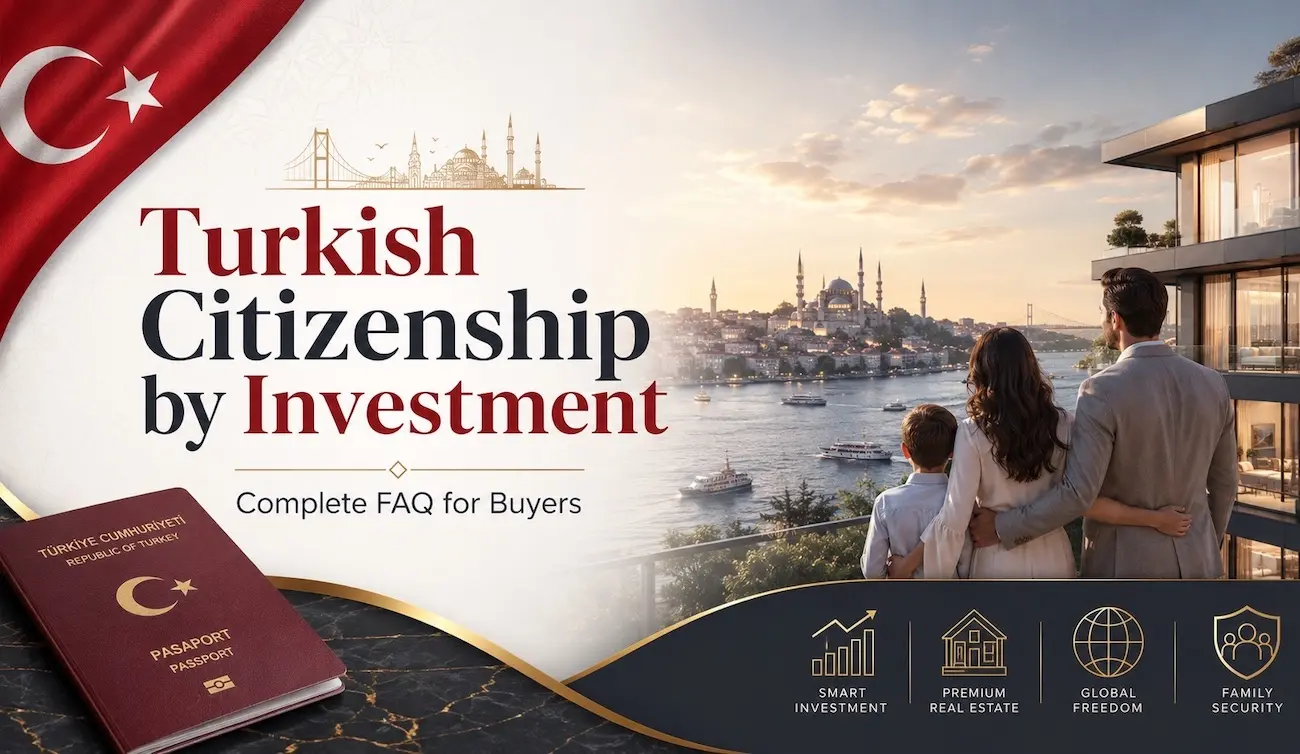
Turkey’s Citizenship by Investment programme is one of the world’s most practical second citizenship routes for property buyers. For a minimum Turkish real estate investment of $400,000 USD, qualifying investors can apply for Turkish citizenship for themselves, their spouse, and children under 18, with no language test, no minimum stay requirement, and a three-year property holding period.
This guide answers the most important questions citizenship buyers ask before investing in Turkish real estate. It covers eligibility, property rules, family inclusion, documents, timelines, valuation, rental income, tax, resale, risks, and how to choose the right investment property.
Questions are grouped by theme. Use the Table of Contents to navigate to the section most relevant to you.
Turkish Citizenship by Investment: Overview and Context
Q1: What is Turkish Citizenship by Investment?
A: Turkish Citizenship by Investment is a government-backed route allowing foreign investors to apply for Turkish citizenship after making a qualifying investment. The most popular route is real estate purchase worth at least $400,000 USD, held for a minimum of three years. Successful applicants receive full Turkish citizenship, not temporary residency.
Q2: What is the minimum investment for Turkish citizenship?
A: The minimum real estate investment is $400,000 USD or equivalent foreign currency. The property must meet the official citizenship criteria, the value must be supported by an approved valuation process, and a three-year no-sale annotation must be placed on the Title Deed.
Q3: Is the Turkish CBI programme still open?
A: Yes. Turkey’s Citizenship by Investment programme remains active. The real estate route continues to be one of the most widely used options, although rules have tightened over time around property type, payment evidence, valuation, seller eligibility, and Title Deed compliance.
Q4: Is Turkish citizenship by investment the same as a Turkish Golden Visa?
A: No. Turkey does not use the term Golden Visa for this route. A Golden Visa usually means residency first, with possible citizenship later. Turkey offers direct citizenship by investment once the qualifying conditions are met. Below the citizenship threshold, property buyers may be able to apply for Turkish residence instead.
Q5: Why do investors choose Turkey for citizenship?
A: Investors choose Turkey because the programme is fast, property-backed, family-inclusive, and does not require a donation, language test, or long residence period. The investment can be rented during the holding period, sold after three years, and combined with a genuine lifestyle or wealth planning strategy.
Q6: Is Turkish citizenship permanent?
A: Yes. Once granted, Turkish citizenship is permanent unless it was obtained through fraud, false information, or a serious legal issue that later invalidates the application. The three-year restriction applies to the investment property, not to the citizenship.
Q7: Is Turkish CBI guaranteed if I buy a $400,000 USD home?
A: No. Buying real estate worth $400,000 USD is the investment requirement, but citizenship is not automatically guaranteed. The property, payment method, valuation, Title Deed restriction, seller background, documents, and security checks must all satisfy the relevant Turkish authorities.
Q8: How long does Turkish citizenship by investment take?
A: A well-prepared application takes 3 to 6 months from property purchase to citizenship approval. Timelines vary depending on document readiness, valuation, land registry processing, conformity certificate issuance, biometrics, security checks, and the workload of government departments.
Eligibility and Main Investment Routes
Q9: Who can apply for Turkish citizenship by investment?
A: A foreign national can apply if they make a qualifying investment, meet the documentation requirements, pass security checks, and are not considered a threat to national security or public order. The applicant must be a real person, not a company, for the real estate route.
Q10: What are the main investment routes for Turkish citizenship?
A: The main routes include buying real estate worth at least $400,000 USD, depositing at least $500,000 USD in a Turkish bank, making a fixed capital investment of at least $500,000 USD, buying qualifying government bonds, buying real estate investment fund or venture capital investment fund shares worth at least $500,000 USD, contributing at least $500,000 USD to the private pension system, or creating jobs for at least 50 people.
Q11: Why is real estate the most popular route?
A: Real estate is the most popular route because it is tangible, easier to understand, and can generate rental income. Investors can also sell the property after the three-year holding period, subject to market conditions.
Q12: Can any nationality apply for Turkish citizenship?
A: Most nationalities can apply, but foreign property ownership in Turkey is subject to country eligibility, reciprocity rules, security restrictions, and land registry checks. Some nationalities may face additional limitations. A buyer should confirm eligibility before reserving or paying for any property.
Q13: Can citizens of countries with weaker passports apply?
A: Yes, provided their nationality is eligible to own property in Turkey and they satisfy the programme rules. Turkish citizenship is popular with investors from countries where visa-free access, banking flexibility, political stability, or family security are key concerns.
Q14: Can EU, UK, US or Canadian citizens apply?
A: Yes. Citizens of the UK, US, Canada, and most European countries can apply if they make a qualifying investment and satisfy the application requirements. Western buyers use Turkish citizenship as a lifestyle, inheritance, mobility, or long-term optionality tool rather than as their primary passport.
Q15: Can a company apply for Turkish citizenship?
A: No. Citizenship is granted to individuals, not companies. A foreign-owned company may invest in Turkish real estate or business activity, but the citizenship by investment real estate route is designed for a person who personally acquires qualifying property.
Q16: Can I apply if I already own property in Turkey?
A: Possibly, but only if the property meets the citizenship rules and the acquisition was structured correctly. Many older purchases do not qualify because the required citizenship annotation, valuation, payment evidence, or timing may not be in place. Each case must be checked individually.
Q17: Can I apply through a property I inherited?
A: Inherited property is not the standard route for citizenship by investment because the programme is based on a qualifying investment acquisition. If you inherited property in Turkey, you should take legal advice before assuming it can be used for citizenship.
Q18: Can I apply if I previously had a Turkish Residence Permit?
A: Yes. A previous or current Turkish Residence Permit does not prevent you from applying for CBI. A short-term Residence Permit is usually obtained as part of the citizenship process after the qualifying investment has been confirmed.
Real Estate Investment Rules
Q19: What type of property qualifies for Turkish CBI?
A: Property must meet the official real estate citizenship rules. Built properties, completed apartments, villas, commercial units, and some properties with condominium ownership or construction servitude can qualify. Since a 2023 rule change, agricultural real estate and non-built land are no longer suitable for citizenship. If a property has land qualification, the condition of being built is required.
Q20: Can I buy one property for $400,000 USD?
A: Yes. You can buy one property worth at least $400,000 USD if it satisfies the valuation, payment, Title Deed, seller, and land registry rules. This is the simplest structure because there is only one Title Deed and one property file to manage.
Q21: Can I buy multiple properties to reach $400,000 USD?
A: Yes. You can combine more than one property to reach the $400,000 USD threshold, provided the properties are acquired correctly and the combined value meets the official criteria. This can be a strong strategy for rental income, especially with smaller city-centre apartments.
Q22: Can I buy two or three apartments instead of one villa?
A: Yes. Many investors prefer two or three smaller apartments instead of one larger property. Smaller units in central locations can be easier to rent, easier to resell, and less dependent on a single tenant. This is often more practical than buying a large lifestyle villa.
Q23: Can off-plan property qualify for Turkish citizenship?
A: Off-plan property can qualify if it is structured through a notarised preliminary sales contract, the required payment is made in advance, the contract is annotated correctly at the land registry, and the property meets the official rules. Buyers must be careful with developer, delivery, and Title Deed risk.
Q24: Can commercial property qualify?
A: Yes. Commercial property can qualify if it satisfies the citizenship programme criteria and the investment value reaches the required threshold. However, commercial property should be assessed carefully for tenant demand, lease terms, VAT, management, resale liquidity, and future buyer profile.
Q25: Can land qualify for Turkish citizenship?
A: Land is no longer a straightforward citizenship route. Recent rules restrict agricultural and non-built land from being used for citizenship purposes. Buyers seeking citizenship should focus on qualifying built property or property with the correct legal status.
Q26: Can shared ownership qualify?
A: Shared ownership is a major risk area. A property acquired in shared ownership with multiple foreign buyers cannot normally be used by each buyer for citizenship. The investment should be registered clearly in the name of the principal applicant, and legal advice should be taken before any shared Title Deed structure.
Q27: Can I buy from another foreigner?
A: This is a restricted area and must be checked before purchase. Property used for Turkish CBI must not belong to a person who acquired Turkish citizenship exceptionally under the investment route, and it must not be property transferred by such a person to a Turkish citizen or company within the last three years. Seller background must be verified before purchase.
Q28: Is there such a thing as a property officially pre-approved for CBI?
A: No. “Pre-approved for citizenship” is usually a marketing phrase, not an official status. A property only becomes suitable for citizenship after the official checks, valuation, payment evidence, Title Deed procedures, and no-sale annotation are completed correctly.
Q29: Can I buy property anywhere in Turkey?
A: Foreigners can buy property in most private ownership areas of Turkey, including Istanbul, Bodrum, Fethiye, Antalya, and many other locations. However, restrictions apply in military zones, special security zones, and areas where foreign ownership limits have been reached.
Q30: Is Istanbul the best location for citizenship investment?
A: For many citizenship buyers, Istanbul is the strongest choice because of year-round rental demand, deep resale liquidity, local population, infrastructure growth, and broad tenant demand. Lifestyle buyers may prefer Bodrum, Fethiye, Antalya, or other coastal locations depending on goals.
Property Valuation, Payment and Title Deed Compliance
Q31: How is the $400,000 USD property value confirmed?
A: The value is confirmed through the official valuation and land registry process. A real estate appraisal report is issued, and the values in the Foreign Currency Purchase Certificate, official deed or preliminary sales contract, receipt, appraisal report, and declared records must support the citizenship threshold.
Q32: What is the appraisal report?
A: The appraisal report is an official valuation report used to confirm whether the property value supports the investment requirement. It protects the government from inflated or artificial pricing and protects the buyer from relying only on the seller’s asking price.
Q33: What happens if the appraisal comes below $400,000 USD?
A: If the official confirmed value falls below the required $400,000 USD threshold, the citizenship application will not qualify on that property alone. The buyer would need to add another qualifying property or restructure the investment before relying on the file for citizenship. This is why valuation risk must be checked before committing funds.
Q34: Can the seller declare a lower Title Deed value?
A: For citizenship purposes, this is dangerous. The declared value, payment evidence, valuation, and foreign currency certificate must support the citizenship threshold. Artificially low Title Deed declarations can create tax, legal, and citizenship problems.
Q35: What is the Foreign Currency Purchase Certificate?
A: The Foreign Currency Purchase Certificate is a required document in the CBI property process. The foreign currency used for the purchase must be sold to a Turkish bank for sale to the Central Bank, and the certificate is submitted as part of the land registry file. The values in the certificate, official deed or preliminary sales contract, receipt, appraisal report, and declared figures must support the $400,000 USD threshold.
Q36: Can I pay directly in USD or euros?
A: No, not directly in the legal completion sense. A property may be marketed or negotiated in USD or Euros, but for CBI the foreign currency must be converted into Turkish Lira through the required Turkish banking process before the Title Deed transaction. The legal file must show compliant bank transfers, foreign currency conversion records, receipts, and land registry values that support the citizenship threshold.
Q37: Can I pay cash for the property?
A: Cash payment is not suitable for citizenship. The authorities need a clear bank record, receipts, currency conversion evidence, and traceable payment trail. Buyers should use formal banking channels and ensure all payments match the legal documentation.
Q38: Can I use cryptocurrency to buy a citizenship property?
A: Crypto wealth can be used, but the property purchase must be completed through the legal banking and land registry system. Turkey does not allow property to be paid for directly in crypto, so the proper route is to convert crypto into compliant fiat funds first, move the money through traceable bank channels, complete the required foreign currency conversion process, and then purchase the property in the normal legal way.
Q39: What is Turkey’s Secure Payment System for property sales?
A: Turkey’s Secure Payment System is designed to protect buyers and sellers during Title Deed transfer. Buyer funds are held through the registered system and released to the seller after completion, creating a safer, traceable payment route for CBI property purchases.
Q40: What Title Deed restriction is placed on the property?
A: A three-year no-sale annotation is placed on the Title Deed of the property. This confirms that the property is being used for Turkish citizenship by investment and cannot be sold during the required holding period.
Q41: Can I sell the property before three years?
A: No. A three-year no-sale annotation is placed on the Title Deed as part of the citizenship process. Selling or attempting to transfer the property before the restriction ends would breach the citizenship investment commitment and can put the application or citizenship status at risk. The investment should be treated as locked for three years.
Q42: What happens after the three-year holding period?
A: After the three-year restriction period ends, the no-sale annotation can be removed through the relevant process, and the property can then be sold, kept, rented, refinanced, or transferred in the normal way, subject to Turkish law and any tax or transaction costs.
Q43: Can I repatriate my money after selling?
A: Yes. Turkey does not impose a general capital lock preventing foreign investors from repatriating sale proceeds after a lawful sale. However, exchange rates, banking procedures, tax, and documentation should be managed correctly.
Q44: What are the main buying costs?
A: The main buying cost is Title Deed transfer tax, generally 4% of the declared value. Other costs may include legal fees, valuation, translations, notarisation, sworn interpreter fees, DASK earthquake insurance, agency fees where applicable, and application-related costs.
Q45: Is VAT payable on Turkish property?
A: VAT may apply to some new-build properties depending on property type, size, developer status, and buyer circumstances. In many residential sales, VAT is already included in the purchase price. Buyers should confirm VAT treatment before signing.
Family Applications and Dependants
Q46: Who is included in a Turkish citizenship application?
A: The principal investor’s spouse and children under 18 can normally be included in the same citizenship application. They receive Turkish citizenship with the main applicant if the application is approved.
Q47: Is there an extra investment required for my spouse?
A: No. The spouse is included under the same qualifying investment. There is no separate $400,000 USD investment requirement for the spouse.
Q48: Are children included at no extra investment cost?
A: Yes. Children under 18 are included under the main application without a separate investment requirement. Administrative, document, translation, and processing costs may still apply.
Q49: Can children over 18 be included?
A: Adult children are not normally included in the same citizenship application. They usually need their own qualifying route if they want Turkish citizenship by investment.
Q50: Can dependent adult children be included?
A: Turkish CBI is generally structured around the spouse and minor children. If there are exceptional dependency issues, specialist legal advice is needed. Buyers should not assume that an adult child can be included automatically.
Q51: Can parents be included in the application?
A: No. Parents of the main applicant are not included under the same real estate citizenship application. They may explore residence options or their own investment route, depending on circumstances.
Q52: Can a second spouse be included?
A: Turkey recognises marriage according to Turkish legal standards. In polygamous family structures, only the legally recognised spouse can normally be included. Families from jurisdictions with different marriage laws should take advice before applying.
Q53: What documents are needed for family members?
A: Family members need passports, birth certificates, marriage certificate for the spouse, photographs, application forms, and other supporting documents. Documents from abroad must be notarised, apostilled or legalised, and translated into Turkish.
Q54: What if my child is born after I receive a Turkish passport?
A: A child born after the parent becomes a Turkish citizen can normally acquire Turkish citizenship through the Turkish parent. The birth must be registered correctly with the relevant Turkish authority, and documents such as the birth certificate, parent ID records, and translations may be required.
Q55: Do all family members need to visit Turkey?
A: Yes, the main applicant and spouse should expect to visit Turkey for biometrics, fingerprints, and identity verification as part of the CBI process. The application can usually start remotely through Power of Attorney, but the biometrics stage must be completed in person. Children’s attendance depends on age and file requirements, so should be confirmed before travel.
Timeline and Application Process
Q56: What are the main stages of the Turkish CBI process?
A: The main stages are property selection, legal due diligence, valuation, payment planning, Title Deed transfer or notarised contract, three-year annotation, Certificate of Conformity, short-term Residence Permit application, citizenship application, biometrics, security checks, approval, and passport issuance.
Q57: What is the Certificate of Conformity?
A: The Certificate of Conformity confirms that the investment meets the required citizenship criteria. For real estate, it is issued after the land registry and relevant authorities check the property, payment, valuation, and Title Deed annotation.
Q58: Can I apply for citizenship before buying property?
A: No. The qualifying investment must be made and confirmed first. You can prepare documents and plan the file before completion, but the citizenship application depends on proof that the investment requirement has been satisfied.
Q59: Can the process begin before I travel to Turkey?
A: Yes. The process can often begin remotely through a properly prepared Power of Attorney. Property search, reservation, document preparation, legal checks, valuation steps, and some administrative work can be started before the investor arrives.
Q60: How long does property purchase take?
A: A straightforward resale purchase can often be completed quickly once due diligence, valuation, payment route, tax number, bank steps, and Title Deed appointment are ready. New-build and off-plan purchases may take longer depending on developer documents and contract structure.
Q61: How long does the citizenship application take after Title Deed transfer?
A: After Title Deed transfer, three-year annotation, and Certificate of Conformity issuance, the citizenship file commonly takes a few months. A 3 to 6 month timeline from purchase to passport is realistic for a well-managed file, although no advisor should promise an exact approval date because security checks and government workload can affect timing.
Q62: Can delays happen?
A: Yes. Delays can happen due to missing documents, inconsistent names, apostille problems, slow police clearances, valuation issues, payment evidence gaps, public holidays, government workload, or additional security checks.
Q63: Can I speed up the process?
A: The best way to speed up the process is to prepare documents correctly before purchase, avoid risky properties, use compliant payment channels, appoint an experienced legal team, and choose a property with clear Title and realistic valuation.
Q64: Who approves the citizenship application?
A: Turkish CBI is granted through the exceptional citizenship process. After the investment is confirmed and the file passes the relevant checks, citizenship is granted by decision of the Turkish authorities.
Q65: Can I obtain a Turkish ID card and passport?
A: Yes. Once citizenship is approved and registration is completed, successful applicants can obtain a Turkish national ID card and apply for a Turkish passport.
Documents, Biometrics and Power of Attorney
Q66: What documents do I need for Turkish CBI?
A: Typical documents include passport copies, birth certificates, marriage certificate if applying with a spouse, children’s birth certificates, biometric photos, police clearance where required, application forms, proof of address, and property-related documents. Requirements vary by nationality and family structure.
Q67: Do documents need to be apostilled?
A: In many cases, foreign documents must be apostilled if issued in an Apostille Convention country. If the country is not part of the Apostille system, legalisation through the relevant authorities and Turkish consulate may be required.
Q68: Do documents need to be translated into Turkish?
A: Yes. Foreign documents normally need certified Turkish translations. The translation and notarisation process should be handled carefully because spelling differences, missing names, or date inconsistencies can delay the application.
Q69: Is a police clearance required?
A: Police clearance is commonly requested as part of citizenship files. Requirements can depend on nationality, residence history, and current procedures. It is best to prepare this early because police certificates can take time.
Q70: Do I need a Turkish tax number?
A: Yes. A Turkish tax number is needed for property purchase, bank procedures, Title Deed transactions, and general administration. It is usually one of the first steps in the purchase process.
Q71: Do I need a Turkish bank account?
A: For a Turkish CBI property purchase, a Turkish bank account is needed to create the correct payment trail, complete the required foreign currency conversion process, obtain bank receipts, and support the citizenship application. The authorities need traceable payments, official bank evidence, and foreign currency conversion documentation that match the Title Deed and valuation records.
Q72: What is Power of Attorney?
A: Power of Attorney allows a trusted lawyer or representative to act on your behalf for specified tasks, such as property purchase, Title Deed transfer, tax number steps, bank coordination, document submission, and citizenship procedures.
Q73: Can I buy property through Power of Attorney?
A: Yes. Foreign buyers can often complete a property purchase through a properly drafted Power of Attorney. The document must be prepared correctly, translated if needed, and accepted by Turkish authorities.
Q74: Can Power of Attorney be issued outside Turkey?
A: Yes. Power of Attorney can be issued abroad, often through a Turkish consulate or local notary with the correct apostille or legalisation. It must include the right powers for the transaction.
Q75: Do I need to give unlimited Power of Attorney?
A: No. Power of Attorney should be specific and limited to the necessary actions. A good legal team will draft it carefully, so your representative has enough authority to complete the process without unnecessary risk.
Q76: What are biometrics?
A: Biometrics are the fingerprints, photographs, and identity verification details taken by Turkish authorities during the CBI process. Even if the purchase and early application steps begin remotely through Power of Attorney, applicants should expect to attend in person for biometrics.
Q77: How long do I need to be in Turkey for biometrics?
A: Applicants usually need to be in Turkey for around 2 to 3 days for biometrics and in-person formalities. Exact timing depends on appointment availability and the stage of the file.
Residency, Language and Physical Presence Rules
Q78: Do I need to live in Turkey to get citizenship by investment?
A: No. Turkish citizenship by investment does not require the investor to live in Turkey before approval. This is one of the programme’s main advantages compared with residence-to-citizenship programmes that require years of physical presence.
Q79: Is there a minimum stay requirement?
A: No. There is no minimum annual stay requirement for the citizenship by investment route. Applicants do not need to relocate or live in Turkey. However, they should expect to visit Turkey for biometrics and in-person formalities.
Q80: Is there a Turkish language test?
A: No. There is no Turkish language test for citizenship by investment. This makes the process more accessible than many naturalisation routes in Europe.
Q81: Do I need to pass an interview?
A: There is no standard language or integration interview, unlike many other naturalisation programmes. However, applicants must still pass document checks, security checks, and administrative review.
Q82: Do I need a Turkish Residence Permit first?
A: Yes. A short-term Turkish Residence Permit is usually part of the citizenship process, after the qualifying investment has been made and confirmed. However, this is a procedural application step, not a requirement to live in Turkey long-term.
Q83: Can I live in Turkey after receiving citizenship?
A: Yes. Turkish citizens have the unrestricted right to live, work, study, open businesses, access services, and remain in Turkey without immigration status limitations.
Q84: Can I work in Turkey after citizenship?
A: Yes. Once you become a Turkish citizen, you can work in Turkey without needing a Work Permit. You can also establish a business, invest, employ staff, and operate commercially, subject to sector-specific rules.
Q85: Can I keep living outside Turkey after approval?
A: Yes. Turkey allows dual citizenship. You are not required by Turkey to renounce your existing nationality. However, your original country’s rules must also be checked because not every country permits dual citizenship.
Q87: How strong is the Turkish passport?
A: The Turkish ordinary passport gives visa-free, visa-on-arrival, or electronic visa access to many destinations worldwide, including parts of Asia, Latin America, the Balkans, Africa, and the Caribbean. It does not give visa-free access to the US, UK, Canada, or the Schengen Area. Passport access changes over time, so buyers should check current visa rules before relying on a specific destination.
Q88: Does Turkish citizenship give EU citizenship?
A: No. Turkey is not a member of the European Union. Turkish citizenship does not give EU citizenship, EU free movement rights, or automatic residence rights in the Schengen Area.
Q89: Can Turkish citizens apply for a US E-2 visa?
A: Turkish citizens are eligible to apply for the US E-2 Treaty Investor visa if they make a qualifying investment in a US business and meet US immigration requirements. The E-2 is not automatic and is separate from Turkish citizenship.
Q90: Can Turkish citizens travel visa-free to the UK?
A: No. Turkish ordinary passport holders need a visa to visit the UK. Buyers should not choose Turkey expecting UK visa-free access.
Q91: Can Turkish citizens travel visa-free to Schengen countries?
A: No. Turkish ordinary passport holders need a Schengen visa for most EU and Schengen travel. Turkey’s passport is useful, but it should not be marketed as an EU-access passport.
Q92: Can my children benefit from Turkish citizenship?
A: Yes. Children included in the application receive Turkish citizenship and can hold a Turkish passport. They may also access education, healthcare, and future residence rights in Turkey as citizens.
Q93: Is Turkish citizenship useful for business owners?
A: Yes. Turkish CBI can help business owners who want easier access to Turkey, a base between Europe, the Middle East, and Asia, Turkish banking options, company setup flexibility, and an additional nationality for family planning.
Tax, Rental Income and Capital Repatriation
Q94: Do I become Turkish tax resident after getting citizenship?
A: Not automatically. Citizenship and tax residency are different. Turkish tax residency usually depends on residence, physical presence, and personal circumstances. A person can be a Turkish citizen but remain tax resident elsewhere.
Q95: Will Turkey tax my worldwide income after citizenship?
A: Citizenship alone does not automatically create Turkish tax residency. If you become Turkish tax resident, Turkish tax rules may apply to your income. Investors with international income should take cross-border tax advice before relocating or restructuring.
Q96: Can Turkish CBI buyers benefit from Turkey’s 20-year foreign income tax exemption?
A: Potentially, yes. Turkey’s 2026 tax rules may benefit qualifying new Turkish tax residents with a 20-year exemption on foreign-sourced income. Citizenship alone does not create the exemption. The key issue is Turkish tax residency, so specialist tax advice is essential.
Q97: Can I rent out my citizenship property?
A: Yes. You can rent out your property during the three-year holding period. The no-sale annotation stops disposal of the property, but it does not prevent rental income.
Q98: What rental yield can I expect?
A: Rental yield depends on location, property type, tenant profile, furnishing, management, and whether the unit is used for long-term or licensed short-term rental. In strong Istanbul districts, well-bought apartments can often generate attractive long-term rental demand.
Q99: Are short-term rentals allowed?
A: Yes, short-term rentals such as Airbnb can be legal in Turkey, but they are regulated. Rentals of up to 100 days fall under Turkey’s short-term rental rules and require the correct tourism-purpose rental permit and building-level compliance. In apartment buildings, permission requirements can make licensing difficult, so not every property is suitable for short-term letting.
Q100: Is rental income taxed in Turkey?
A: Yes. Rental income from Turkish property is taxable in Turkey, subject to applicable allowances, expenses, declarations, and tax rules. A property management and accounting team should help investors report rental income properly.
Q101: Is there capital gains tax when I sell?
A: Yes, capital gains tax can apply in Turkey if you sell the property within five years of purchase. It is generally calculated on the taxable gain, not the full sale price, after permitted adjustments such as inflation indexing and any applicable exemption. If an individual holds the property for more than five years, the sale is generally exempt from Turkish capital gains tax.
Q102: Can I sell after three years and keep citizenship?
A: Yes, provided the citizenship was properly obtained and the three-year no-sale commitment has been satisfied. After the restriction ends, you can sell the property and keep Turkish citizenship. Selling after three years does not cancel citizenship.
Property Strategy for Citizenship Buyers
Q103: What type of property does Property Turkey recommend for CBI buyers?
A: For many citizenship investors, we recommend affordable city-centre Istanbul apartments, especially one and two-bedroom units in districts with strong transport, universities, hospitals, offices, and local tenant demand. This strategy prioritises liquidity, rentability, and resale depth.
Q104: Why are one-bedroom apartments popular with investors?
A: One-bedroom apartments are popular because they have a wide tenant base, lower entry price, easier furnishing costs, and strong rental demand from professionals, students, young couples, and short-term renters where licensed. They can also be easier to resell than larger units.
Q105: Are two-bedroom apartments also a good option?
A: Yes. Two-bedroom apartments can suit families, professionals sharing, longer-term tenants, and resale buyers who want more space. They may produce slightly lower percentage yields than one-bedroom units, but they often offer broader end-user appeal.
Q106: Should I buy luxury property for citizenship?
A: Luxury property can be suitable for lifestyle buyers, but it is not always the best investment route. High-end villas or branded residences may have fewer tenants, higher maintenance costs, and a narrower resale audience. Citizenship investors should prioritise fundamentals over prestige.
Q107: Is Bodrum suitable for Turkish citizenship investment?
A: Bodrum is suitable for buyers who want lifestyle value, premium coastal ownership, villa living, and seasonal rental potential. It can be excellent for personal use or moving to Turkey, but buyers should understand seasonality and resale dynamics before choosing Bodrum for investment.
Q108: Is Antalya suitable for citizenship investment?
A: Antalya can suit buyers seeking tourism demand, coastal lifestyle, rental income, and a lower price point than some Istanbul or Bodrum markets. However, property selection is key because oversupply and location quality vary significantly.
Q109: Is Fethiye suitable for citizenship investors?
A: Fethiye is attractive for lifestyle buyers, British retirees, and seasonal rental investors. It is less liquid than Istanbul but can work well for buyers who want a second home, access to nature, and long-term personal use alongside citizenship.
Q110: Is Istanbul Urban Regeneration a good strategy?
A: Istanbul’s Urban Regeneration areas such as Kağıthane and parts of Şişli can offer strong value when the project is central, transport-connected, legally clean, and priced correctly. The opportunity is strongest where old housing stock is being replaced by modern apartments in established districts with real local demand.
Q111: Should I buy the cheapest property that qualifies?
A: No. The cheapest qualifying property is not always the best investment. Some low-priced options are in weak locations, have poor resale demand, inflated valuations, or weak rental fundamentals. A citizenship property should still stand up as a real investment.
Q112: Can Property Turkey manage my property after purchase?
A: Yes. Property Turkey Management & Lettings can assist with furnishing, tenant search, long-term rental, short-term rental where legally suitable, rent collection, maintenance, inspections, and resale planning. For overseas investors, management is essential.
Risks, Mistakes and Due Diligence
Q113: What is the biggest mistake CBI buyers make?
A: The biggest mistake is buying a property only because it is marketed as suitable for citizenship. The property must be legally compliant, fairly valued, rentable, resalable, and aligned with the investor’s goals. Citizenship approval and investment quality should both be treated equally.
Q114: What due diligence should be done before buying?
A: Due diligence should check Title Deed status, debts, mortgages, zoning, occupancy permits, developer history, valuation risk, seller eligibility, payment route, management costs, rental prospects, and whether the property can legally support the citizenship application.
Q115: Can developers inflate prices for citizenship buyers?
A: Yes. Some sellers target foreign citizenship buyers with inflated pricing. This is why independent valuation, market comparison, legal review, and an experienced buyer-side advisor are critical.
Q116: What happens if the property has debt or a mortgage?
A: Existing debts, mortgages, liens, or legal encumbrances can delay or block the transaction. These must be checked before completion and cleared or handled legally before Title Deed transfer.
Q117: What if the developer does not finish the project?
A: Off-plan buyers face delivery risk. If the developer delays, fails, or changes the project, the buyer may face investment and legal problems. Citizenship buyers should only use off-plan structures where the legal route, developer record, and Title Deed process are strong.
Q118: Can I lose money on the property?
A: Yes. Turkish real estate can rise or fall in value. Currency movements, location, supply, demand, build quality, management, and entry price all affect performance. Citizenship should not be used as an excuse to ignore investment fundamentals.
Q119: Is currency risk important?
A: Yes. Turkish property sales and rental contracts must be completed in Turkish Lira, even when a property is marketed or negotiated in USD or Euros. For CBI buyers, foreign currency is transferred into Turkey, converted through the required banking process, and supported by official conversion and payment records. Rental income and local ownership costs are also in Turkish Lira, so investors should understand exchange-rate exposure before buying.
Q120: Are there restrictions on foreign ownership area limits?
A: Yes. Foreign buyers are subject to legal limits, including a maximum land acquisition area and restrictions in certain security zones. In normal city apartment purchases this is rarely a problem, but it should still be checked.
Q121: Should I use a lawyer?
A: Yes. A citizenship buyer should always have proper legal representation. The lawyer should review the property, seller, documents, payment route, Title Deed annotation, citizenship file, and Power of Attorney before funds are committed.
Q122: Can Property Turkey protect me from bad investments?
A: Property Turkey cannot remove all investment risk, but our experience helps buyers avoid common mistakes. We focus on legally compliant property, realistic valuation, strong rental demand, clear Title, reputable sellers, and long-term resale logic.
Comparisons with Other Citizenship and Residency Programmes
Q123: How does Turkey compare with Malta citizenship?
A: Malta offers access to the EU but is significantly more expensive, more selective, and slower. Turkey does not provide EU citizenship, but it offers a lower real estate threshold, a faster route, no donation requirement, and a major lifestyle market.
Q124: How does Turkey compare with Portugal Golden Visa?
A: Portugal offers residency, not immediate citizenship. Citizenship may be possible later if legal residence and language requirements are met. Turkey offers direct citizenship after a qualifying investment, with no language test and no long residence requirement before approval.
Q125: How does Turkey compare with UAE Golden Visa?
A: The UAE Golden Visa gives long-term residence, not citizenship. Turkey gives full citizenship and a passport. The UAE may suit business and tax residency goals, while Turkey suits buyers who want a second nationality backed by real estate.
Q126: How does Turkey compare with Caribbean citizenship programmes?
A: Caribbean programmes can be cheaper and faster, especially donation routes. Turkey is different because it offers citizenship in a G20 economy, a large domestic property market, real estate ownership, strong lifestyle appeal, and proximity to Europe, the Middle East, and Central Asia.
Q127: How does Turkey compare with Greece Golden Visa?
A: Greece offers residency through investment, with potential citizenship only after years of residence and integration. Turkey offers direct citizenship through a qualifying investment. Greece offers Schengen access as a resident; Turkey offers a second passport but not Schengen visa-free access.
How PropertyTurkey.com Can Help You
Q128: What services does Property Turkey provide for citizenship buyers?
A: Property Turkey provides end-to-end support, including property sourcing, acquisition advice, legal coordination, due diligence, valuation guidance, Title Deed procedures, citizenship application support, family document preparation, finance guidance, property management, lettings and rental services, and resale planning after the three-year holding period.
Q129: Does Property Turkey only sell property?
A: No. Property Turkey is a full-service real estate platform for international buyers, sellers, and investors. We support clients before, during, and after purchase through property search, acquisition advice, legal and finance guidance, citizenship coordination, management and lettings, exit strategy, design, construction, and long-term ownership support.
Q130: Can Property Turkey help me choose between Istanbul, Bodrum, Antalya and Fethiye?
A: Yes. We operate across Turkey’s key real estate markets and help buyers compare investment-led, lifestyle-led, and hybrid options. Istanbul usually suits rental and resale liquidity. Bodrum, Fethiye, and Antalya may suit lifestyle and seasonal rental goals.
Q131: Can Property Turkey help with legal documents?
A: Yes. Our in-house legal and professional network helps coordinate the documentation process, including translations, notarisation, apostille guidance, Power of Attorney, Title Deed checks, family documents, and citizenship application preparation.
Q132: Can Property Turkey help with property management?
A: Yes. Property Turkey Management & Lettings supports owners after purchase with long-term lettings, short-term lettings where legally suitable, routine inspections, maintenance coordination, guest support, tenant handling, check-ins, check-outs, rent collection, and financial reporting. This is important for overseas citizenship investors.
Q133: Can Property Turkey help after I receive citizenship?
A: Yes. Our relationship continues after approval. We can help with rental management, resale planning, portfolio growth, relocation support, schools, lifestyle advice, company setup introductions, and future property acquisitions.
Q134: Why use Property Turkey instead of buying directly from a developer?
A: Developers sell their own stock. Property Turkey advises across the market and represents the buyer’s interests. We compare locations, projects, resale options, rental potential, valuation risk, legal suitability, and citizenship compliance, so buyers are not limited to one developer’s inventory or pressured into unsuitable property.
Q135: How experienced is Property Turkey?
A: Property Turkey has been guiding international buyers in Turkey since 2001. We have helped thousands of clients through multiple market cycles, legal changes, currency shifts, citizenship rule updates, and investment trends. This experience is valuable when rules are technical, and mistakes are costly.
Q136: Can Property Turkey help me avoid non-compliant properties?
A: Yes. We screen properties for citizenship suitability, seller background, Title Deed status, valuation logic, payment compliance, rental fundamentals, resale potential, and legal risk before recommending them. This helps reduce the chance of buying a property that looks attractive but later fails the citizenship process.
Q137: How do I start the process with Property Turkey?
A: Contact Property Turkey with your nationality, family structure, budget, preferred timeline, and main goal: citizenship, investment, lifestyle, rental income, or a combination. Our advisors will assess your profile, explain the correct process, and present suitable property options that match both the citizenship rules and your investment strategy.
Speak to PropertyTurkey.com Today
Turkish Citizenship by Investment is one of the most practical routes to a second passport through real estate. For $400,000 USD, investors can acquire qualifying property, include their spouse and children under 18, rent the property during the holding period, and sell after three years while keeping citizenship.
The opportunity is strongest when citizenship planning and property investment are treated together. A weak property can still create problems, even if it meets the threshold. A strong investment should be legally compliant, fairly valued, easy to rent, realistic to resell, and located in a market with genuine long-term demand.
PropertyTurkey.com has guided international investors through Turkish real estate since 2001. Our in-house legal and advisory team can help you choose the right property, structure the process correctly, manage the citizenship application, and protect your investment after purchase. Contact us today for a free consultation with our experts.
London · Istanbul · Bodrum · Fethiye · Antalya · UAE | Est. 2001
Disclaimer: This guide is for informational purposes only. Turkish citizenship rules, property eligibility criteria, tax treatment, document requirements, government fees, and processing timelines can change. Nothing in this guide constitutes legal, tax, immigration, or financial advice. Always seek qualified professional advice before making investment decisions.
END
Subscribe To Our Media
Sign up To Save, Explore & Revisit Your Favourite Properties.
Sign up To Save, Explore & Revisit Your Favourite Properties.
Forget Password
Property Enquiry
Apply Now
Sense Sisli central Istanbul 10% income properties


















 X
X