Short Answer: Turkey is the only one of the seven where an investment leads to citizenship, not just residency, and its entry point is $400,000 USD in real estate. Greece, Portugal, and Italy offer renewable Residence Permits from EUR 250,000 to EUR 500,000 or more. Thailand asks for $1m USD in assets plus $500,000 USD invested. Florida’s E-2 is temporary and only for treaty-country nationals. Spain closed its investor route on 3 April 2025.
Residency or Citizenship: Why the Difference Matters
A Residence Permit lets you live in a country. It has to be renewed, and the rules can change. Citizenship does not expire. It comes with a passport, and in Turkey’s case you can keep your existing nationality, because Turkey allows dual citizenship.
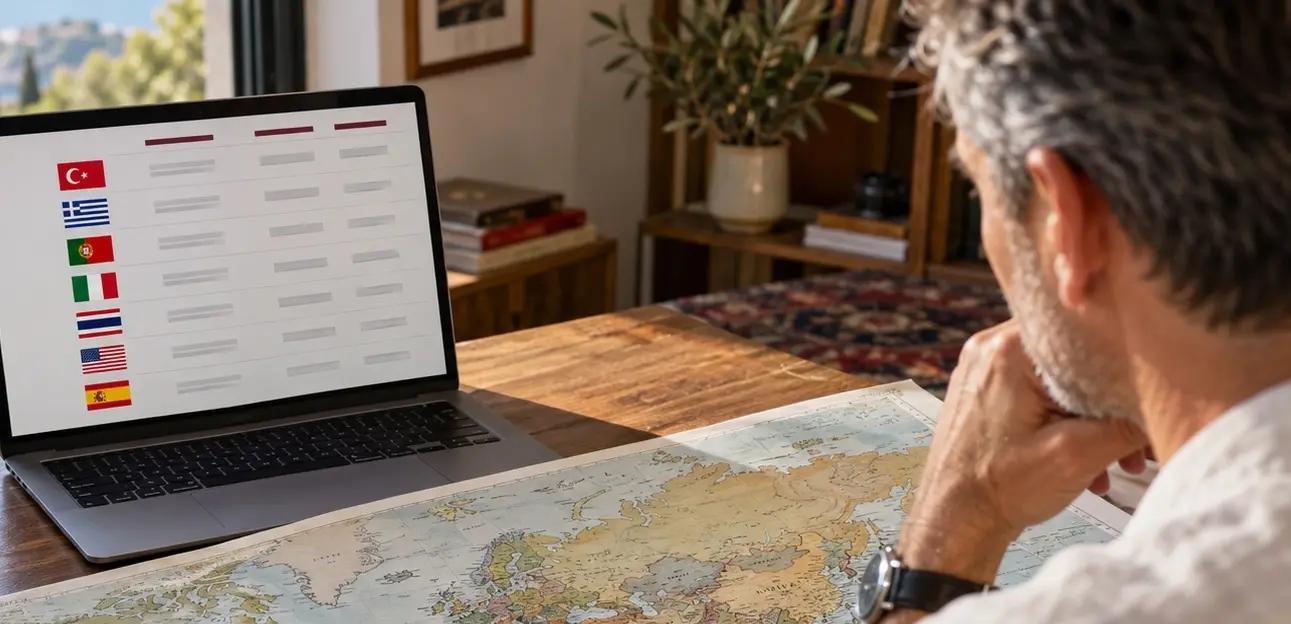
That is why Turkey’s route is a different kind of outcome from the alternatives, not just a cheaper one. It is also why Turkey is the strongest scorer on this factor (5 out of 5), with Greece, Portugal, Italy, and Florida on 3, and Thailand and Spain on 2.
Residency and Citizenship Routes Compared
Country
What You Get
Entry Point
The Catch
Evidence
Turkey
Citizenship for you, your spouse, and children under 18
$400,000 USD in real estate; $500,000 USD for a bank deposit, bonds, or a fund
Three-year no-sale annotation on the Title Deed; independent valuation must meet the threshold
EUR 400,000 for one home; EUR 800,000 in Attica, Thessaloniki, Mykonos, Santorini, and islands over 3,100 people; EUR 250,000 only for conversions or listed buildings
Home must be at least 120 m2 for the two main tiers; only 61% of February 2026 files had a decision by August
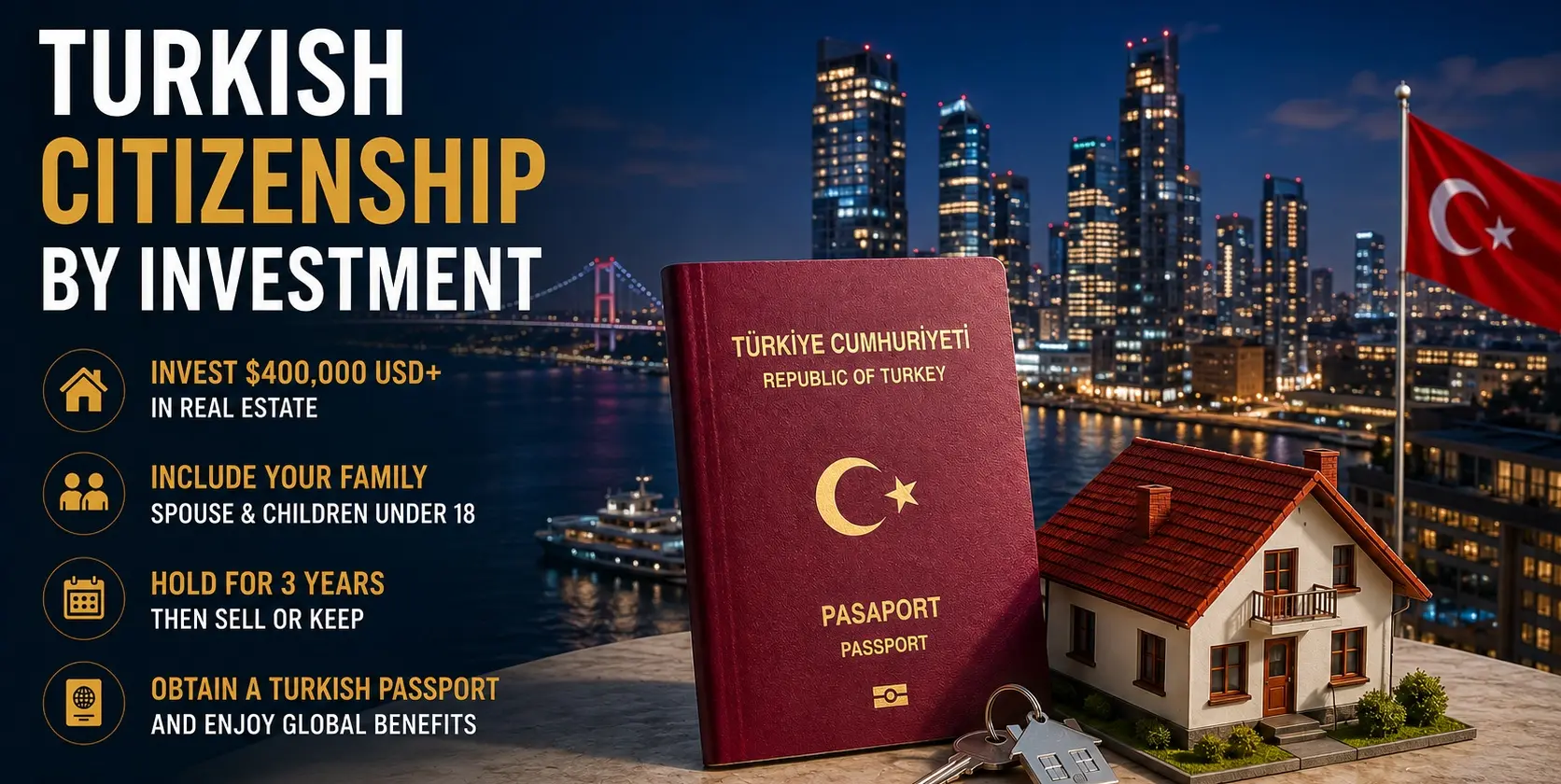
The route to Turkish citizenship by investment is set by Article 12 of the Turkish Citizenship Law, No. 5901. The qualifying investments are:
- Real Estate: At least $400,000 USD. This is the lowest threshold and the one most buyers use.
- Bank Deposit, Government Bonds, or Fund Shares: $500,000 USD each.
- Fixed Capital Investment: $500,000 USD.
- Job Creation: At least 50 jobs for Turkish citizens.
The main conditions are the same across the routes:
- Hold Period: The asset must be kept for at least three years from the date the restriction is placed on the Title Deed.
- Valuation: A property must be valued by a licensed appraiser, and the value must meet the $400,000 USD threshold or the conformity certificate is refused.
- Proof of Foreign Currency: The currency exchange certificate (DAB) shows that the money came from abroad and was properly converted.
- Family: Your spouse and children under 18 are included in the same application.
- Residence: There is no requirement to live in Turkey continuously.
In 2026 the Turkish authorities tightened valuation standards and foreign-exchange traceability, and the land registry now looks harder at conformity certificate applications. A professionally handled file is more important than it used to be.
How Long it Takes and What it Costs
A realistic range for each stage: property due diligence 1 to 6 weeks, property valuation 1 to 6 weeks, conformity certificate 2 to 12 weeks, investor Residence Permit 2 to 12 weeks, citizenship decision 4 to 24 weeks, and ID card and passport 1 to 4 weeks.
End to end, the best case is about three to four months, the average is six to nine months, and complex cases can pass 12 months. Advisers quote three to six months for a clean file. On top of the investment, the reported costs are:
Cost
Reported Amount
Title Transfer Tax
About 4% of the declared sale value ($16,000 USD on a $400,000 USD purchase)
Official Valuation
$1,000 USD to $3,000 USD
Stamp Duty and Notary Fees
$500 USD to $1,500 USD
Local Legal Fees
$5,000 USD to $15,000 USD
Translation and Apostille
$500 USD to $2,000 USD
What Turkish Citizenship Does Not Do
Citizenship is not the same as tax residency. Turkey treats you as a tax resident if your legal residence is there or you stay more than six months in a calendar year. Becoming a citizen does not change where you are taxed, so plan your tax position separately.
Turkey’s new 20-year exemption on foreign-source income, published in Law 7582 on 4 June 2026, is aimed at qualifying new residents. It covers foreign income only, with a 1% inheritance tax during the exemption period. It does not cover Turkish rent, dividends, or fees earned in Turkey.
One more point. Adult male Turkish citizens aged 20 to 41 have a military service obligation, and a paid discharge option exists whose amount changes with each piece of legislation. Check the current terms before you apply.
When Another Country is the Better Choice
Turkish citizenship does not give you EU residence rights. If your goal is to live and work inside the EU, the permits in Greece, Portugal, and Italy might be the right tools, with different trade-offs. Greece starts at EUR 400,000 for one home, but only 61% of files lodged in February 2026 had a decision by August. Portugal no longer accepts property and wants EUR 500,000 in a fund or company. Italy’s route needs a start-up or company investment, not property. The US E-2 can be the cheapest start, with no fixed minimum, but it is temporary and only open to nationals of treaty countries.
FAQs: Easiest Country for Residency by Investment
Q: What is the minimum investment for Turkish citizenship in 2026?
A: $400,000 USD in real estate, or $500,000 USD in a bank deposit, government bonds, fund shares, or fixed capital. Another route is creating at least 50 jobs for Turkish citizens.
Q: How long does Turkish citizenship by investment take?
A: Reported timelines run from about three months in the best case to six to nine months on average. Complex files can take more than a year.
Q: Can my family be included?
A: Yes. Your spouse and children under 18 are included in the same application.
Q: Do I have to live in Turkey?
A: No. There is no requirement to reside in Turkey continuously.
Q: Can I keep my current nationality?
A: Yes. Turkey allows dual citizenship.
Q: Which country has the cheapest residency by investment?
A: Florida’s E-2 has no fixed minimum, commonly $50,000 USD to $200,000 USD, but it is temporary and only for treaty-country nationals. Next come Italy’s EUR 250,000 start-up route and Greece’s EUR 250,000 route for conversions or listed buildings. Turkey’s $400,000 USD buys citizenship rather than a permit.
Q: Is Spain’s golden visa still open?
A: No. Spain closed its investor route on 3 April 2025.
Q: How Property Turkey can help
A: Property Turkey’s real estate and legal teams help overseas buyers with the Turkish tax number, the bank account, the property purchase, and the citizenship application. Speak to our team before you commit to a property, because the valuation and the foreign-currency paperwork decide whether the file is accepted.
Cameron Deggin Founder & CEO, Property Turkey
Cameron Deggin is Founder and CEO of Property Turkey. A former finance professional and FCCA-qualified accountant, he founded the company in 2001 after recognising Turkey’s investment potential. With more than two decades analysing Turkish real estate, Cameron regularly advises international investors and is quoted by media including the Financial Times and BBC.




 By:
By:


 Founder & CEO, Property Turkey
 Bodrum
  2
2  1
1 







 X
X