
Short Answer: Portugal scores highest overall (72.6 out of 100), with Turkey a close second (71.6) and Greece third (70.2). At that gap, the right pick depends on your business. Turkey is best for fast bank accounts, low staff costs, and citizenship by investment from $400,000 USD. Portugal is the safer all-rounder: fastest to incorporate, and free of Turkey’s inflation and payment-platform problems. Thailand, Florida, Spain, and Italy trail.
Scorecard: Which Country is Easiest for a Small Business Owner?
Portugal scores highest at 72.6 out of 100, with Turkey at 71.6, and Greece at 70.2. The top three are 2.4 points apart. A one-point change to a single score on a factor weighted 10% moves a total by 2 points, so treat them as a cluster, not a ranking. Florida, Thailand, Spain, and Italy sit at least 7 points behind. Scores run from 1 (weakest of the seven) to 5 (strongest). Each is a judgement anchored on the evidence tables below.
| Factor (Weight) |
Portugal |
Turkey |
Greece |
Florida (US) |
Spain |
Thailand |
Italy |
| Tax burden (15%) |
4 |
3 |
4 |
3 |
3 |
3 |
2 |
| Residency route (12%) |
3 |
5 |
3 |
3 |
2 |
2 |
3 |
| Bank account (12%) |
3 |
5 |
3 |
4 |
3 |
2 |
2 |
| International payments (10%) |
4 |
2 |
4 |
4 |
4 |
3 |
4 |
| Setup speed and cost (10%) |
5 |
4 |
3 |
3 |
3 |
2 |
2 |
| Red tape (10%) |
3 |
3 |
3 |
3 |
3 |
2 |
2 |
| Labour (10%) |
3 |
4 |
3 |
2 |
2 |
4 |
2 |
| Operating costs (8%) |
3 |
5 |
4 |
1 |
3 |
5 |
3 |
| Stability and currency (8%) |
4 |
1 |
4 |
4 |
4 |
4 |
4 |
| Market access (5%) |
5 |
3 |
5 |
5 |
5 |
3 |
5 |
Portugal, Turkey, and Greece Lead under Every Weighting
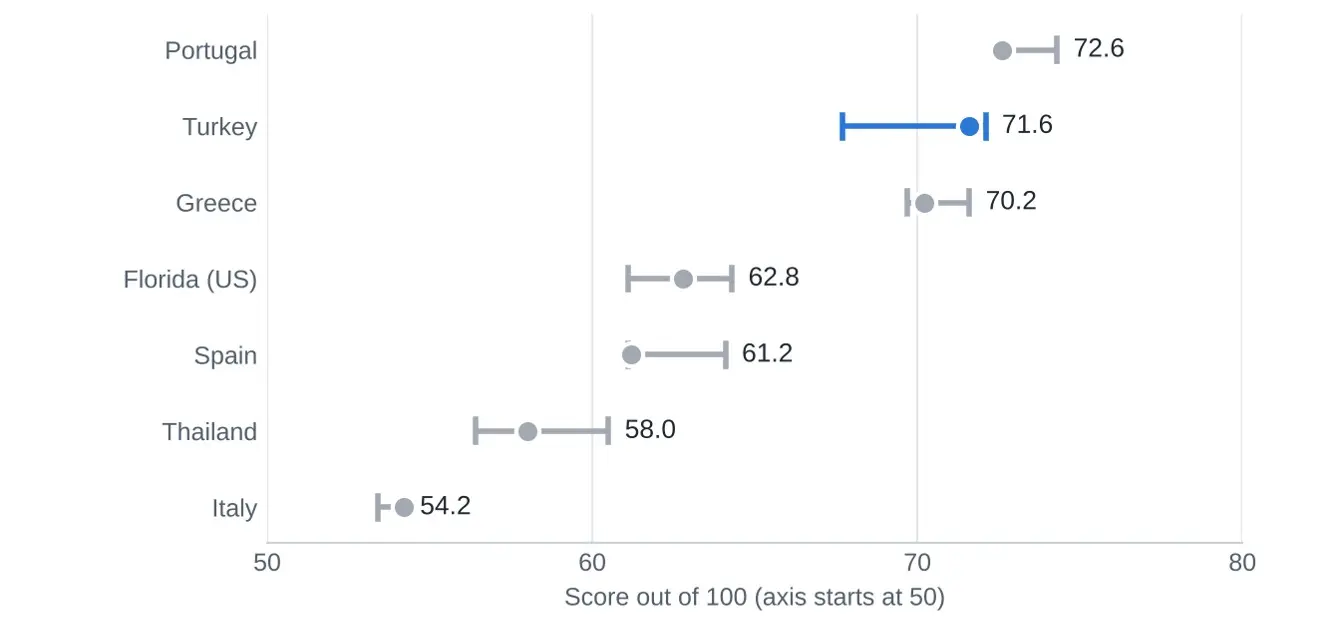
Dot: Overall score on the base weights.
Line: Lowest to highest across four weightings.
Property Turkey analysis, 3 October 2026.
| Weighting |
1st |
2nd |
3rd |
| Base weights |
Portugal |
Turkey |
Greece |
| Owner keeps most (tax and operating costs counted 1.5 times) |
Portugal |
Turkey |
Greece |
| Fast start (bank, payments and setup counted 1.5 times) |
Portugal |
Turkey |
Greece |
| No residency (residency weight set to zero) |
Portugal |
Greece |
Turkey |
Where Turkey Leads and Trails: It scores highest on residency and bank account and is joint highest with Thailand on operating costs and labour. It scores lowest of the seven on international payments, and on stability and currency.
Turkey’s Rank Leans on Residency: With the residency factor set to zero, Turkey falls to third (67.7) behind Greece (71.6). Citizenship from $400,000 USD is something none of the other six offers, so the lean is real, but an owner who does not want residency should read the no-residency row.
Turkey’s Bank Score is First-party: It rests on PT’s own account openings, while the other six rest on adviser ranges. Allow for that by marking Turkey down one point, from 5 to 4, and its total falls to 69.2, third behind Greece at 70.2.
Provisional Scores: Payments scores for the six non-Turkish countries rest on Stripe coverage and published payment rules, not on timed transfers. Thailand scores 3 because remittances above $50,000 USD need a Foreign Exchange Transaction form; the other five score 4. Hiring speed is evidenced for Turkey only. Stability and market access are scored from published indicators, set out under their sections.
How We Scored
Each country gets a score from 1 to 5 on ten factors. The factors are weighted by how often owners search for them, then combined into a score out of 100. Every score carries a source and a date.
| # |
Factor |
Weight |
The Question Owners Search |
| 1 |
Tax burden |
15% |
What will I actually keep after tax? |
| 2 |
Residency route |
12% |
Can I get residency or citizenship through the business? |
| 3 |
Bank account |
12% |
Can a foreigner open a business account, and how fast? |
| 4 |
International payments |
10% |
Can I send and receive USD / EUR, and take profit out? |
| 5 |
Setup speed and cost |
10% |
How long does it take to register a company? |
| 6 |
Red tape |
10% |
How much paperwork will I carry every year? |
| 7 |
Labour |
10% |
Can I find and afford staff, from cleaners to engineers? |
| 8 |
Operating costs |
8% |
What does it cost to run the business each month? |
| 9 |
Stability and currency |
8% |
Is my money safe from inflation and rule changes? |
| 10 |
Market access |
5% |
Can I sell easily into the markets I care about? |
Three Kinds of Evidence, Labelled in Every Table:
- PT Data: Counts and timings from Property Turkey’s own clients since 2019 (3,000+ clients). These describe PT-assisted openings and hires, not walk-in results.
- Official: A government, tax authority, or central bank source, with its date.
- Reported: Published guidance from local advisers. We score these cautiously and mark them until a local practitioner confirms them.
Sensitivity Check: We rerun the ranking under four weightings: the base weights above; owner keeps most (tax and operating costs counted 1.5 times); fast start (bank, payments, and setup counted 1.5 times); and no residency (the residency factor set to zero, so the ranking does not lean on investor programmes). A country only wins a category if it holds its place under all four.
The World Bank stopped publishing its Doing Business ranking in 2021 after data irregularities. Its successor, Business Ready (B-READY), is rolling out in stages (Greece and Portugal in 2024, Italy and Spain in 2025, Thailand planned for 2026), so it cannot yet give a like-for-like score for all seven countries. This scorecard fills that gap from the point of view of an owner-managed business.

Tax Burden: Where Does a Small Business Owner Keep the Most?
Portugal has the lowest headline company tax for a small owner-managed business. Turkey sits mid-table at 25%, and its strongest tax card is for the owner personally, not the company.
| Country |
Standard Company Tax |
Small or New Company |
Also Worth Knowing |
Evidence |
| Portugal |
19%, falling to 17% by 2028 |
15% on the first EUR 50,000 (SMEs) |
Licensed Madeira regime at 5% to 2033 |
Reported: GrowIN Portugal |
| Thailand |
20% |
0% to THB 300,000 and 15% to THB 3m, only with paid-up capital under THB 5m and revenue under THB 30m, which most foreign-owned firms exceed |
BOI-promoted firms can get tax holidays and 100% foreign ownership |
Reported: PwC Tax Summaries |
| Greece |
22% flat |
No small-company rate |
5% tax on dividends to individuals |
Reported: Tsamichas Law |
| Spain |
25% |
23% under EUR 10m turnover; 19% / 21% scale under EUR 1m; 15% for a new company’s first two profitable years |
None to add |
Reported: Moraleda |
| Florida (US) |
Pass-through LLC: no entity tax. C-corp: 21% federal plus 5.5% Florida above $50,000 USD |
Pass-through LLC, owner taxed at federal rates |
No state personal income tax |
Reported: Jargo |
| Turkey |
25% |
20% on export income; 12.5% on certified manufacturers’ production income from 2027 |
15% dividend withholding (reported); 20 years of zero tax on foreign-source income for qualifying new residents |
Official: Law 7582 record |
| Italy |
24% IRES plus 3.9% IRAP, about 27.9% combined |
No reduced rate; IRAP is due even with no profit |
EUR 300,000 flat tax on foreign income for new residents |
Reported: Your Business in Italy |
What Turkey’s April 2026 Package Became: Parliament passed Law 7582 on 21 May 2026 and it was published on 4 June 2026. The 9% and 14% exporter rates announced in April were not adopted in that form. What the law did enact:
- A 12.5% rate for certified manufacturing and agricultural production income, from the 2027 tax year. It cannot be combined with the existing five-point export reduction.
- The five-point export reduction continues, so pure exporters pay 20%.
- A 20-year exemption from Turkish income tax on foreign-source income for qualifying new residents, with a 1% inheritance tax during the exemption period.
For a trading, services, or property business, the company rate is 25% unless it exports. The owner-level exemption is the real difference, and it applies only to foreign-source income, not Turkish rent, dividends or fees earned in Turkey.
Residency Route: Which Country Turns a Business or Investment into Residency?
Turkey is the only one of the seven where an investment leads to citizenship, not just residency, and its entry point is $400,000 USD. Spain has closed its investor route altogether.
| Country |
What You Get |
Entry Point |
The Catch |
Evidence |
| Turkey |
Citizenship for you, your spouse, and children under 18 |
$400,000 USD in real estate; $500,000 USD for a bank deposit, bonds or a fund |
Three-year no-sale annotation on the Title Deed; independent valuation must meet the threshold |
Reported: Global Law Experts |
| Greece |
5-year renewable residence permit |
EUR 400,000 for one home; EUR 800,000 in Attica, Thessaloniki, Mykonos, Santorini, and islands over 3,100 people; EUR 250,000 only for conversions or listed buildings |
Home must be at least 120m2 for the two main tiers; only 61% of February 2026 files had a decision by August |
Reported: Digicare |
| Italy |
2-year investor permit, renewable |
EUR 250,000 in an innovative start-up; EUR 500,000 in a company; EUR 1m donation; EUR 2m in bonds |
No property route; optional EUR 300,000 a year flat tax on foreign income |
Reported: Mbersani Law |
| Portugal |
Residence permit |
EUR 500,000 in a qualifying fund, research, or a job-creating company; EUR 250,000 for cultural projects |
Property has not qualified since 2023 |
Reported: Global Citizen Solutions |
| Thailand |
10-year Long-Term Resident visa |
$1m USD in assets plus $500,000 USD invested in Thailand |
Investment must be made and held before applying; annual reporting to the BOI |
Reported: Expatica |
| Florida (US) |
E-2: renewable temporary status. EB-5: green card |
E-2: no fixed minimum, commonly $50,000 USD to $200,000 USD. EB-5: $800,000 USD in a targeted area or $1.05m USD, plus 10 jobs |
E-2 is only for nationals of treaty countries |
Reported: Visa for the United States |
| Spain |
Nothing from an investment |
Investor route closed on 3 April 2025; entrepreneur, non-lucrative, and digital nomad visas remain |
Entrepreneur visa is judged on the business plan, with no fixed amount |
Reported: Pellicer & Heredia |
Timelines are Reported, not Guaranteed: About 3 to 9 months end to end for Turkey, and 6 to 9 months for Greece, where the Ministry’s own data shows decisions running behind the two-month legal limit.
Residency and citizenship are different products. A Residence Permit has to be renewed and can be affected by changes in the rules. Citizenship does not expire. That is where Turkey’s route is a different kind of outcome from the alternatives, not just a cheaper one.

Bank Account: Where is a Business Account Fastest to Open?
Turkey is fastest for a PT-assisted foreign owner: same day for a personal account and about three days for a foreign-owned company. Only a Florida LLC at a fintech bank comes close, and only once it holds an EIN.
| Country |
Needed First |
Company Account, Foreign-owned (Typical) |
Main Catch |
Evidence |
| Turkey |
Tax number |
1 day for locals; about 3 days for foreign-owned (e.g. Monday to Thursday) |
Few banks accept Iranian applicants, mainly Ziraat Bank |
PT Data |
| Florida (US) |
Formed LLC, EIN, passport |
A few business days at fintech banks such as Mercury or Relay |
Non-resident EIN reported at 3 to 6 weeks; traditional banks mostly decline non-residents |
Reported: LLC Starters |
| Spain |
Company NIF; NIE for the signatory at many banks |
1 to 5 business days once documents are complete |
Notarised, apostilled power of attorney; remote opening has limits |
Reported: Capital Auditors |
| Greece |
AFM tax number, registered company |
About 1 to 2 weeks, longer for non-resident founders |
Extra KYC for non-EU owners; no official timeline published |
Reported: Global Citizen Solutions |
| Portugal |
NIF, then incorporated Lda and beneficial-owner filing |
10 business days to 6+ weeks, by bank and nationality |
Traditional banks usually need a branch appointment |
Reported: GrowAcross |
| Italy |
Codice fiscale, registered SRL |
2 to 6 weeks for foreign directors |
Banks may ask for an Italian-resident director |
Reported: Lawzana |
| Thailand |
Thai company, long-term visa, often a work permit |
Needs a director in the branch with visa or work permit |
Bangkok Bank has refused tourist and DTV visa holders since January 2026 |
Reported: Commenda |
What PT Sees: Since 2019, Property Turkey has opened personal accounts for about 95% of its 3,000+ foreign clients, roughly 2,850. The rest already held an account or chose not to open one. The order is tax number first, then the account, and for nearly every nationality it happens the same day. A company account needs the same paperwork as for a local and no minimum deposit. These are Property Turkey-assisted openings, not walk-in results. Iranian applicants are the exception: only a few Turkish banks accept them, so the door is narrower for them, not closed.
The figures for the other six countries are ranges from local advisers. Banks set their own timelines, and in Greece no official account-opening timeline is published. We replace each range with a local practitioner’s confirmation wherever we can get one.

International Payments: Can you Send and Receive Money Easily?
Turkey’s weakness is online payment platforms, not bank transfers. A Turkish-registered company cannot open Stripe, and PayPal has been unavailable since 2016. Bank-to-bank payments work, and get faster once a payee is established.
Card Payments from Overseas Customers: Stripe’s own country list (checked 3 October 2026) includes Spain, Italy, Greece, Portugal, Thailand, and the United States. Turkey is not on it. PayPal left Turkey in 2016, and most 2026 sources say it has not returned. Reported workarounds, none as simple as a Stripe account:
- Local gateways such as iyzico and PayTR, built for Turkish buyers rather than overseas ones.
- Merchant-of-record services such as Paddle, which handle tax and chargebacks but add fees, including a flat 15 (USD, EUR or GBP) on each international SWIFT payout.
- A US or EU company to hold the Stripe account, which adds a second set of filings.
Bank Transfers (PT Data): Turkish accounts can be held in USD, GBP, and EUR. A first SWIFT payment takes 3 to 4 days in each direction. Once the payee is established, payments can arrive in as little as one day, and Property Turkey’s own transfers to the UK go out the same day.
Who this Affects: A business that is paid by bank transfer, such as property, construction, consulting, or export trade, is not held back. An e-commerce or software business that takes cards from overseas customers will need one of the workarounds above before it can trade smoothly from a Turkish company.
Taking Profit Out: Turkish law lets foreign investors transfer net profits, dividends, and the proceeds of selling or liquidating an investment abroad, subject to tax, with no pre-approval for foreign investment. Exporters are a separate case: the Central Bank has required them to sell part of their foreign-currency earnings and cut that share from 40% to 30% in June 2024. The ratio has changed over time, so check the current level before modelling export cash flow.

Setup Speed and Cost: How Long Does It Take to Register a Company?
Portugal is the fastest to incorporate. Turkey is next, at about a week with a low capital floor. Thailand is the most restrictive for foreign owners, and Italy and Spain are the slowest for non-residents.
| Country |
Time to Register |
Main Catch |
Evidence |
| Portugal |
About 1 hour in person (Empresa na Hora, EUR 360), or 5 to 10 business days online |
Capital from EUR 1; a NIF is needed first |
Reported: GrowAcross |
| Turkey |
About 1 week, mostly spent waiting for paperwork from overseas; tax number in 1 to 3 days |
Capital TRY 50,000 (about EUR 877); 100% foreign ownership allowed; the owner’s own Work Permit needs far more capital (sources say TRY 100,000 to 500,000) |
PT Data. Reported: Investment.com.tr |
| Greece |
Name reserved same day; bank account 1 to 3 weeks; no overall timeline published |
IKE company from EUR 1 capital, 100% foreign-owned; AFM tax number needed first |
Reported: Global Law Experts, Zuna |
| Florida (US) |
Online through Sunbiz; EIN for a non-resident reported at 3 to 6 weeks |
State fee $125 USD and $138.75 USD a year; Florida registered agent required; owner names are public |
Reported: Startfleet |
| Spain |
4 to 6 weeks standard; 5 to 10 working days on the CIRCE fast track for a simple SL; 8 to 12 weeks reported for non-resident directors |
Capital from EUR 1 (EUR 3,000 recommended); NIE needed |
Reported: Renn, Neoretos |
| Italy |
SRL about 4 to 6 weeks; full set-up including the bank often 6 to 12 weeks |
Foreign directors often find the bank is the bottleneck |
Reported: Your Business in Italy |
| Thailand |
Registration 1 to 3 days once documents are signed; 3 to 4 weeks end to end; 3 to 6 months if a Foreign Business Licence is needed |
Foreign ownership capped at 49% in most activities unless BOI promotion, a licence or the US Treaty of Amity applies; THB 2 million capital per foreign Work Permit |
Reported: Emerhub |
Turkish sources disagree on timing (from 3 business days to 4 weeks) and on whether capital must be deposited at incorporation. PT’s own experience is about a week for a foreign-owned company, and most of that is waiting for paperwork from overseas rather than the registration itself. The monthly cost of a mandatory accountant in Turkey is covered under red tape, not here.

Red Tape: What Does it Take to Stay Compliant Every Year?
All seven countries need professional help to run a company, so the real question is what you must pay for and what you must file. Turkey’s burden is a mandatory licensed accountant and fully electronic invoicing, all in Turkish. Thailand’s is a compulsory audit, even for a dormant company. Florida’s is one form that carries a $25,000 USD penalty if missed.
| Country |
Professional Required |
Typical Cost |
The Filing that Bites |
Evidence |
| Turkey |
Licensed accountant (SMMM), by law |
About TRY 5,000 to 9,000 a month |
E-invoice, e-archive invoice, and monthly e-ledger; books kept in Turkish and Lira; TRY 5,000 fine per paper invoice where e-invoicing applies |
Reported: Turkish Company Setup |
| Portugal |
Certified accountant, by law |
EUR 100 to 350 a month |
Monthly SAF-T invoice file, beneficial-owner register, annual IES return by July |
Reported: GrowIN Portugal |
| Spain |
Gestor or accountant, essential in practice |
EUR 100 to 500 a month |
Quarterly VAT, annual accounts filed with the Mercantile Registry |
Reported: FL Jordan |
| Greece |
Licensed accountant (logistis), by law |
EUR 2,400 to 6,000 a year for a small company with no staff |
Real-time myDATA e-books; B2B e-invoicing phasing in from 2026 |
Reported: Winsight |
| Italy |
Commercialista, effectively mandatory for a foreign-owned SRL |
EUR 1,500 to 4,000 a year, more for complex firms |
E-invoicing through SdI, PEC email and digital signature, annual accounts, EUR 309.87 books tax |
Reported: Studio Ponchio |
| Thailand |
Licensed CPA audit every year for every limited company, even a dormant one |
THB 20,000 to 100,000+ for the audit alone |
No small-company audit exemption |
Reported: Emerhub |
| Florida (US) |
No statutory accountant requirement in the sources reviewed |
Not priced in the sources reviewed |
Form 5472 with a pro forma 1120 every year for a foreign-owned single-member LLC, even with no income; $25,000 USD penalty per missed form; state annual report USD 138.75 |
Reported: Taxes for Expats |
Turkey’s electronic systems are described by one compliance provider as among the most advanced in the world. The cost to the owner is that every filing goes through a licensed Turkish accountant, in Turkish, on official platforms.
On annual cost the Turkish, Portuguese, Italian, and Spanish ranges overlap, so none of them wins on price alone. Thailand’s audit and Florida’s penalty exposure are the two items most owners do not budget for.

Labour: How Easy and Affordable is it to Hire?
Turkey’s wage floor and employer costs are well below the four Euro-area countries and Florida, and Property Turkey fills ordinary roles the same day. Rare technical talent and foreign staff are the exceptions.
| Country |
Minimum Wage (Gross) |
Employer Social Cost |
Evidence |
| Turkey |
TRY 33,030 a month |
About 22.5%, less 2 to 5 points with the SGK incentive; all-in about TRY 40,214 at the minimum wage |
Reported: Rona Legal |
| Thailand |
THB 337 to 400 a day, by province |
5%, capped at THB 875 a month |
Reported: Teamed |
| Portugal |
EUR 1,073 a month (Eurostat’s 12-month equivalent) |
23.75% |
Official: Eurostat via Euronews. Reported: Trading Economics |
| Greece |
EUR 1,073 a month (Eurostat’s 12-month equivalent) |
About 22% |
Same sources as Portugal |
| Spain |
EUR 1,425 a month (Eurostat’s 12-month equivalent) |
30.65% |
Official: Eurostat via Euronews. Reported: PwC Tax Summaries |
| Italy |
No statutory minimum; set by collective agreements |
About 30%; sources range up to 39% |
Reported: Trading Economics |
| Florida (US) |
$15.00 USD an hour from 30 September 2026 |
7.65% FICA, plus 0.6% federal and 2.7% Florida unemployment tax on the first $7,000 USD of pay |
Reported: Miami Payroll Center |
What PT Sees: From cleaners to professionals, Property Turkey can usually fill a role the same day with a single call. PT’s all-in monthly employer cost is about $1,200 USD for a cleaner and $1,500 USD to $2,000 USD for a skilled professional. The legal floor is about $820 USD all-in, so PT’s cleaner figure sits above it. A professional on TRY 60,000 gross costs the employer TRY 73,620, about $1,500 USD, which is consistent with PT’s range.
Where Turkey is Harder:
- Highly technical people are difficult to find unless the employer is large enough to attract them quickly.
- A foreign employee needs a Work Permit, and employers generally must keep five Turkish employees on payroll for each foreign hire. Founders get a grace period and some sectors are exempt.
- Thailand’s equivalent is THB 2 million of paid-up capital for each foreign Work Permit.
Hiring speed in the other six countries is not yet evidenced beyond the wage and cost data above. We add local practitioner timings before this row is scored.

Operating Costs: What Does it Cost to Run the Business Each Month?
Turkey and Thailand are the cheapest of the seven to live in and run a business from, and the United States costs more than twice as much as either.
Cost of Living plus Rent Index 2025
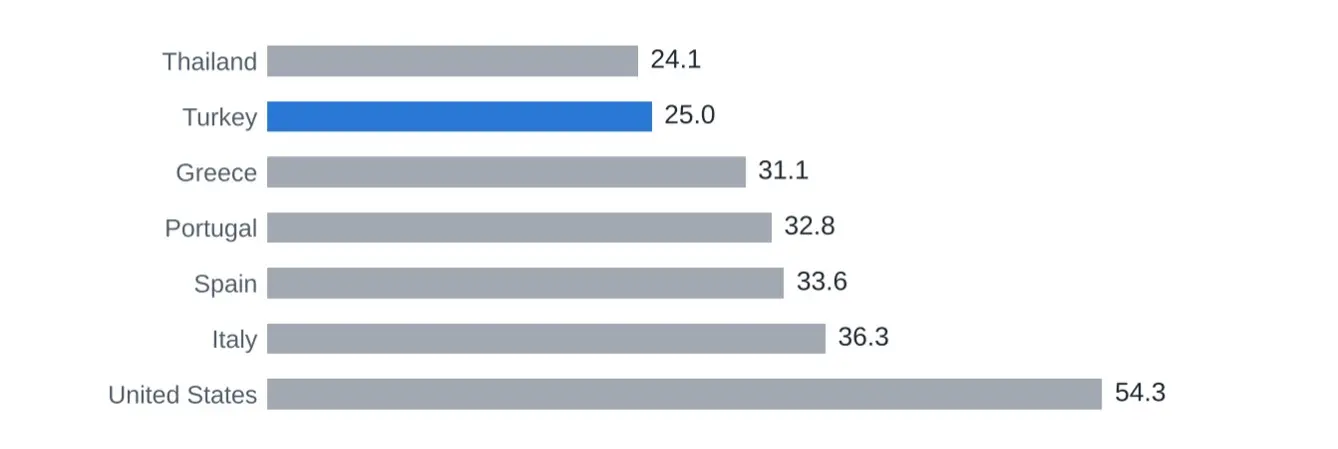
Source: Numbeo via World Population Review, read 3 October 2026.
This index measures everyday living costs plus rent, so it is a proxy for what the owner and staff spend, not a full business cost. Payroll is covered under labour, and professional fees under red tape.
Two limits. The US figure is national, so Miami or Fort Lauderdale will differ. And office rent is not compared here because no like-for-like rent data was found; we add city-level quotes rather than guess. Turkey’s cost advantage is also narrowing in Dollar terms, which the stability section explains.

Stability and Currency: How Safe is Your Money from Inflation?
Turkey’s inflation is 31.5% a year, against 2.5% to 4.5% in the other countries. It is the biggest risk in this comparison, and it steadily erodes Turkey’s cost advantage in Dollar terms.
Annual Consumer Price Inflation, August 2026
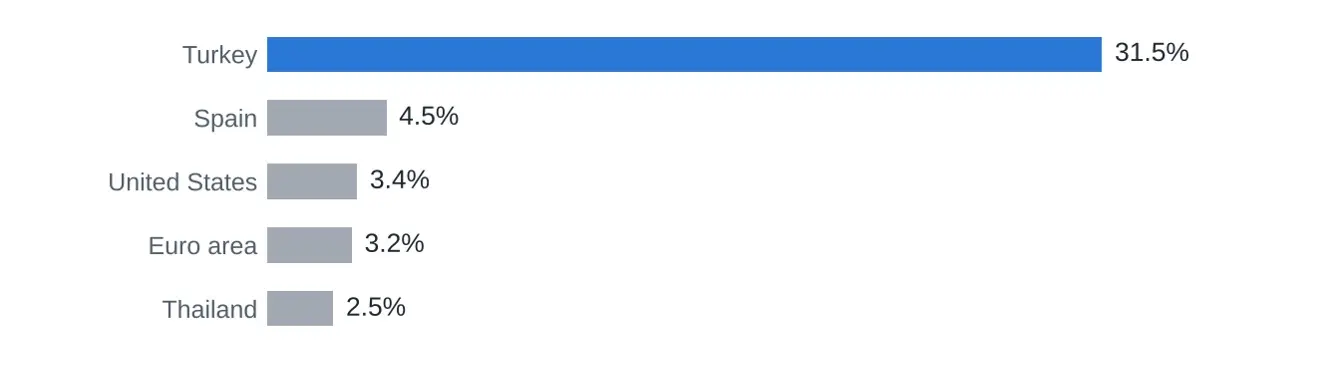
Sources: Trading Economics (Turkey, US), Eurostat (Euro area), Agence Europe (Spain), FocusEconomics (Thailand), read 3 October 2026.
What it Does to Costs: Turkey’s Central Bank has let the Lira fall more slowly than prices rise, a strategy Trading Economics describes as maintaining real appreciation. Over the past year prices rose about 31.5% while the Dollar rose about 18% against the Lira, so costs paid in Lira rose roughly 11% in Dollar terms. A business that bills in Dollars or Euros and pays staff and rent in Lira loses some margin to that gap each year.
What PT Data Adds: Turkish banks offer USD, GBP, and EUR accounts, so revenue does not have to sit in Lira.
Elsewhere: Euro-area inflation was 3.2% in August, with Spain’s flash estimate at 4.5%. Thailand was 2.5% and the United States 3.4%.
Rule of Law: The World Justice Project scores every country from 0 to 1 on how well its rules are applied. Turkey is the lowest of the seven.
| Country |
Score (0 to 1) |
Global Rank (of 143) |
| Spain |
0.71 |
25 |
| United States |
0.68 |
27 |
| Portugal |
0.67 |
29 |
| Italy |
0.66 |
34 |
| Greece |
0.60 |
48 |
| Thailand |
0.50 |
77 |
| Turkey |
0.41 |
118 |
How the Stability Score is Set: It averages an inflation score and a rule-of-law score, each from 1 to 5, with a half rounded up. Inflation: under 3% scores 5, 3% to 3.9% scores 4, 4% to 4.9% scores 3, 5% to 9.9% scores 2, and 10% or more scores 1. Rule of law: 0.70 or more scores 5, 0.65 to 0.69 scores 4, 0.55 to 0.64 scores 3, 0.45 to 0.54 scores 2, and below 0.45 scores 1. Turkey scores 1 on both. Thailand scores 5 on inflation but 2 on rule of law, so 4. Spain scores 3 and 5, so 4. Greece scores 4 and 3, so 4. Portugal, Italy, and Florida score 4 on both, using Euro-area inflation for Portugal and Italy.

Market Access: Which Base Gives the Best Reach into the Markets You Sell to?
Turkey is the only non-EU country of the seven with a customs union with the EU, which makes it a real manufacturing base for European sales. The four EU countries have the whole single market, and Florida has the US domestic market.
Turkey: Since 1 January 1996, industrial goods and processed agricultural products in free circulation move between Turkey and the EU without customs duty, proved with an A.TR certificate. Services, most agriculture, and public procurement are outside it.
Where Turkey is Exposed: It does not automatically share in the EU’s new trade deals. The EU’s agreement with India, concluded in January 2026, gives EU firms near-zero access to India while Turkish exporters still face India’s standard tariffs. Carbon-intensive Turkish exporters also face the EU’s CBAM from 2026.
Spain, Italy, Greece, and Portugal: Full EU single-market access for goods and services, and settlement in Euros.
Florida: Direct access to the US domestic market.
Thailand: It has 17 free trade agreements covering 24 trading partners, including the ASEAN agreements and RCEP, which entered into force on 1 January 2022. There is no EU deal yet; the government aims to conclude talks by the end of 2026. Thailand scores 3 on this factor, level with Turkey.
This factor is most important to exporters and manufacturers. Combined with the 12.5% production tax rate that starts in 2027, it is the strongest reason to put a factory in Turkey rather than a trading office. Lifestyle is personal, so we leave it out of the score.

Verdict: Which Country is Best for Your Type of Business?
No country wins for every owner. We re-weighted the scorecard for each business type (the weights are in the methodology section) and the order changes.
| Owner Type |
Ranking on the Re-weighted Scorecard |
Why |
The Catch |
| Digital or remote business (software, online services, e-commerce) |
Portugal 73.6, Greece 71.6, Turkey 69.3 |
Payments and bank access carry the most weight, and Portugal and Greece have no platform gaps |
A Turkish company cannot open Stripe, so Turkey suits this type only when clients pay by bank transfer |
| Exporter or manufacturer |
Portugal 75.0, Greece 73.7, Turkey 69.8 |
Market access carries the most weight, and the EU countries sit inside the single market |
For a certified manufacturer on the 12.5% rate, raising Turkey’s tax score from 3 to 4 lifts it to 73.5, level with Greece. It also has a customs union with the EU and a wage floor of about $674 USD `a month |
| Hospitality, property, or services sold locally |
Turkey 75.4, Portugal 69.7, Greece 68.1 |
Staff and running costs carry the most weight, and local customers pay locally, so Turkey’s payment gap matters little |
Inflation of 31.5% erodes the cost edge. With residency set aside, Turkey (72.0) leads Portugal (71.0) by one point |
| Lifestyle business |
Not scored |
The choice is driven by the residency route, not the business: citizenship from $400,000 USD in Turkey, EU residence in Greece (property from EUR 400,000) or Portugal (funds from EUR 500,000) |
Spain’s investor route closed in April 2025, and Thailand needs $1m USD in assets plus $500,000 USD invested |
The pattern is consistent. Turkey wins when the business is staff-heavy and sells locally, or when the owner wants the passport. It loses ground when the business depends on card platforms or on Euro stability.

FAQs: Best Country to Start a Small Business
Q: Which country is easiest to start a business in?
A: Portugal scores highest (72.6 out of 100), narrowly ahead of Turkey (71.6) and Greece (70.2). The top three are close enough that the best choice depends on your type of business.
Q: Which country is fastest for opening a business bank account?
A: Turkey, for a foreign owner using Property Turkey: same day for a personal account and about three days for a foreign-owned company account. A Florida LLC at a fintech bank is next fastest, once it holds an EIN. Portugal and Italy can take several weeks.
Q: Can a foreigner open a bank account in Turkey?
A: Yes. Since 2019, Property Turkey has opened personal accounts for about 95% of its 3,000+ foreign clients, nearly all the same day once the Turkish tax number is issued. Iranian applicants are the exception: only a few banks, mainly Ziraat Bank, accept them.
Q: Which country is fastest to register a company?
A: Portugal: about one hour in person at Empresa na Hora (EUR 360), or 5 to 10 business days online. Turkey takes about one week, mostly spent waiting for overseas paperwork. Spain and Italy are slowest for non-residents (about 4 to 12 weeks), and Thailand is the most restrictive for foreign owners.
Q: Can a foreigner own 100% of a company in Turkey?
A: Yes. Foreign ownership of 100% is allowed, with minimum capital of TRY 50,000 (about EUR 877). The owner’s own Work Permit needs far more capital; sources say TRY 100,000 to 500,000.
Q: What is the corporate tax rate in Turkey?
A: 25% is the standard rate. Export income is taxed at 20%, and certified manufacturers’ production income at 12.5% from the 2027 tax year. The two reductions cannot be combined.
Q: Did Turkey cut corporate tax to 9% for exporters?
A: No. The 9% and 14% exporter rates announced in April 2026 were not adopted. Law 7582, published on 4 June 2026, enacted 12.5% for certified production income from 2027, and pure exporters stay at 20%.
Q: Is foreign income exempt from tax in Turkey?
A: For qualifying new residents, yes: Law 7582 exempts foreign-source income from Turkish income tax for 20 years, with a 1% inheritance tax during that period. It does not cover Turkish rent, dividends, or fees earned in Turkey.
Q: Which country has the lowest tax for a small business?
A: Portugal has the lowest headline rate for a small owner-managed company: 15% on the first EUR 50,000, and 19% standard, falling to 17% by 2028. Greece is 22% flat, Turkey 25%, and Italy about 27.9% with IRAP. A Florida pass-through LLC pays no entity tax, but the owner pays federal income tax.
Q: Which of these countries gives citizenship for an investment?
A: Only Turkey. $400,000 USD in real estate, or $500,000 USD in a bank deposit, bonds, or a fund, gives citizenship to you, your spouse, and children under 18, with a three-year no-sale annotation on the Title Deed. The other six offer Residence Permits or visas, not citizenship.
Q: What is the cheapest route to residency by investment?
A: Florida’s E-2 has no fixed minimum, commonly $50,000 USD to $200,000 USD, but it is temporary and only for nationals of treaty countries. Next come Italy’s EUR 250,000 start-up route and Greece’s EUR 250,000 route for conversions or listed buildings; Greece’s standard property route starts at EUR 400,000. Turkey’s $400,000 USD buys citizenship rather than a permit.
Q: Is Spain’s golden visa still open?
A: No. Spain closed its investor route on 3 April 2025. The entrepreneur, non-lucrative, and digital nomad visas remain.
Q: Can a Turkish company use Stripe or PayPal?
A: Not Stripe: Turkey is not on Stripe’s country list. PayPal left Turkey in 2016. Workarounds are local gateways such as iyzico and PayTR, merchant-of-record services such as Paddle, or a US or EU company that holds the Stripe account.
Q: How long do international transfers from Turkey take?
A: On Property Turkey’s own data, a first SWIFT payment takes 3 to 4 days in each direction. Once the payee is established, payments can arrive in as little as one day, and PT’s transfers to the UK go out the same day. Accounts can be held in USD, GBP, and EUR.
Q: How much does it cost to employ someone in Turkey?
A: The legal minimum is TRY 33,030 gross a month (about $674 USD), or about $820 USD all-in with employer costs. Property Turkey’s all-in figures are about $1,200 USD for a cleaner and $1,500 USD to $2,000 USD for a skilled professional.
Q: Is it easy to find staff in Turkey?
A: For ordinary roles, yes: PT can usually fill a role from cleaner to professional the same day with one call. Two exceptions: highly technical people are hard to find unless the employer is large, and a foreign employee needs a Work Permit, with five Turkish employees generally required per foreign hire.
Q: Do I need an accountant in Turkey?
A: Yes. A licensed accountant (SMMM) is required by law, at about TRY 5,000 to 9,000 a month. Filing runs through e-invoice, e-archive, and e-ledger systems, in Turkish.
Q: Is inflation a problem for a business in Turkey?
A: It is the biggest risk in the comparison. Inflation is 31.5% a year against 2.5% to 4.5% in the other countries, and costs paid in Lira rose roughly 11% in Dollar terms over the past year. Turkish banks offer USD, GBP, and EUR accounts, so revenue does not need to sit in Lira.
Q: Does Turkey have free trade with the EU?
A: Partly. Under the customs union (since 1 January 1996), industrial goods and processed agricultural products move between Turkey and the EU without customs duty. Services, most agriculture, and public procurement are outside it, and Turkey does not automatically share in the EU’s new trade deals.
Q: Which country is cheapest to run a business from?
A: Thailand and Turkey, at 24.1 and 25.0 on the Numbeo cost of living plus rent index, against 31.1 to 36.3 for Greece, Portugal, Spain, and Italy, and 54.3 for the United States. This is a proxy for living costs, and Turkey’s edge is narrowing in Dollar terms because of inflation.

Methodology, Sources, and Last-verified Date
Last Verified: 3 October 2026: Every figure is sourced beside the row it supports. Inflation, exchange-rate, and interest-rate figures move monthly.
How the Scores were Set: Each factor is scored from 1 to 5 against the other six countries, using the evidence in the tables above, then weighted by how often owners search for it. The tables are the evidence; the scores are our reading of it. Stability averages an inflation score and a rule-of-law score. Market access scores 5 for the EU single market or the US domestic market, and 3 for Turkey and Thailand, which have broad trade agreements but not full single-market access. The three re-weightings and the no-residency check are described under how we scored. The owner-type verdicts use these weights, with every total rescaled to 100:
- Digital or remote: payments counted 2 times, bank account and tax 1.5 times, labour 0.5 times.
- Exporter or manufacturer: market access 3 times; labour, operating costs, and tax 1.5 times; residency 0.5 times.
- Local services: labour and operating costs 1.5 times, payments 0.5 times, market access zero.
What PT Data Is: Counts and timings from Property Turkey’s own clients since 2019 (3,000+ clients). They describe PT-assisted outcomes, not walk-in results, and they underpin Turkey’s bank score, its hiring evidence, its transfer timings, and its company registration time. The scorecard shows what happens when the bank score is discounted by a point.

Cameron Deggin  Founder & CEO, Property Turkey
Cameron Deggin is Founder and CEO of Property Turkey. A former finance professional and FCCA-qualified accountant, he founded the company in 2001 after recognising Turkey’s investment potential. With more than two decades analysing Turkish real estate, Cameron regularly advises international investors and is quoted by media including the Financial Times and BBC.
View full author profile →




 By:
By:

 Bodrum
  2
2  1
1 










 X
X