Quick Answer:If you're weighing Turkish citizenship, one warning will reach you sooner or later: a Turkish passport brings your worldwide estate into Turkish inheritance tax. It does. But the tax falls on your heirs, not on you; rates run 1% to 10% after per-heir exemptions, and foreign tax paid is deductible. If you become a qualifying new Turkish tax resident, they pay a flat 1% should you die within 20 years. The UK's rate is up to 40%. The question isn't whether the tax exists, but whether your residency, structure, and timing are set up correctly. Done properly, it's manageable.
1. Will a Turkish Passport Bring my Worldwide Estate into Scope?
Yes. Turkey's Inheritance and Transfer Tax Law (No. 7338) taxes free transfers of property belonging to Turkish citizens, wherever it sits, as well as any property located in Turkey. Once you naturalise, your foreign assets sit inside the Turkish net. Three facts keep that in proportion:
1. It Taxes a Transfer, not Ownership: The tax arises when property passes at death or by gift. Turkey levies no annual wealth tax.
2. The Heir Pays: The taxpayer is the person who receives the property, not the person who owns it.
3. The Reach has an Edge: A foreign person who doesn't live in Turkey and inherits a Turkish citizen's assets located abroad is outside the tax. Your spouse and children under 18 are normally included in a citizenship application, so plan on them being Turkish citizens and in scope. Adult children who aren't Turkish citizens and don't live in Turkey may fall outside it for assets held abroad. Treat that as a point for specialist advice, not an assumption.
2. What Would my Heirs Actually Pay?
Each heir pays on their own share, after a personal exemption, on a scale that rises from 1% to 10%. For 2026 the exemption is about $58,400 USD for each child and for the surviving spouse, or about $116,900 USD where the spouse inherits alone and there are no descendants. Dollar figures are converted at the Central Bank rate dated in the notes under the tables.
Slice of Taxable Inheritance (USD, Approx.)
Rate
First $60,300 USD
1%
Next $140,600 USD
3%
Next $301,400 USD
5%
Next $602,700 USD
7%
Above $1,105,000 USD
10%
NOTE: USD figures converted at the Central Bank of the Republic of Türkiye's indicative USD/TRY rate of 30 October 2026 (49.7747), rounded. The legal thresholds are set in Turkish Lira and revalued each January, so their USD equivalents move with the exchange rate.
Two illustrations for a child receiving a share, using the ordinary scale and the 2026 exemption:
Inheritance Received (USD)
Taxable after Exemption (USD)
Tax (USD)
Effective Rate
$400,000 USD
about $341,600 USD
about $11,900 USD
about 3.0%
$2,000,000 USD
about $1,941,600 USD
about $145,700 USD
about 7.3%
NOTE: Converted at the Central Bank of the Republic of Türkiye's indicative USD/TRY rate of 30 October 2026 (49.7747), rounded. The tax is worked on the ordinary scale and 2026 exemption above.
Four practical points to consider:
1. Instalments: The tax can be paid in six equal instalments over three years, in May and November.
2. Filing: A return is required even when the share falls below the exemption. The deadline runs from four to eight months after death, depending on where the death occurred and where the heir lives.
3. Property: Inherited real estate can't be sold or charged until the tax on it is paid in full or security is given.
4. Indexation: Brackets and exemptions are revalued every year, and their USD equivalents move with the exchange rate, so these 2026 figures will change.
Gifts sit on a separate, higher scale, with a reduced rate for gifts between close family. How and when assets pass is important.
3. Can I Reduce or Manage It?
Yes, in four practical ways:
1. Deduct Foreign Tax and Debt: Inheritance tax already paid abroad on your foreign assets, and debts attached to them, come off the Turkish taxable base. They must be documented and declared, and the deduction can't exceed the value of those assets. It is a deduction, not a credit, so it lowers the base rather than the bill one for one.
2. Use Every Exemption: The exemption applies per heir, so an estate shared between a spouse and several children uses several exemptions.
3. Spread the Payment: Six instalments over three years ease the cash-flow hit on illiquid estates.
4. Plan the Succession Itself: Succession is generally governed by the deceased's national law, while Turkish law applies to immovable property in Turkey. Turkish succession law also gives close family reserved shares that limit what a Will can do. A Will drafted with both in mind avoids surprises.
4. Is There a Better Rate Available?
Yes: a flat 1% for qualifying new residents. Law No. 7582, published in the Official Gazette on 4 June 2026, added Article 20/D to the Income Tax Law, exempting qualifying foreign-source income of new Turkish tax residents for 20 years. The same law amends the Inheritance and Transfer Tax Law so that anyone benefiting from that exemption has inheritance taxed at 1%, in place of the scale in section 2, when death falls within the 20-year period. To qualify, you need to do three things:
1. Become a Turkish Tax Resident on or After 1 January 2026:Resident means domiciled in Turkey, or living there continuously for more than six months in a calendar year.
2. Have a Clean Three-year Record: You must have had no Turkish domicile and no Turkish tax liability in the three calendar years before you became resident. Earlier Turkish tax on property income, investment income, or capital gains doesn't count against you. Earlier wage or business income does, and so does a Turkish domicile in that window.
3. Obtain the Exemption Certificate: Apply to your tax office by the end of the calendar year in which you become resident, or by the end of February the following year if you become resident in the last two months.
Three limits are important to consider:
- Residency, Not the Passport, is the Test: Citizenship alone doesn't unlock the 1% rate, and a citizen who stays non-resident doesn't qualify.
- Inheritance Only: The statute refers to inheritance, so treat gifts as staying on the ordinary scale until your adviser confirms otherwise.
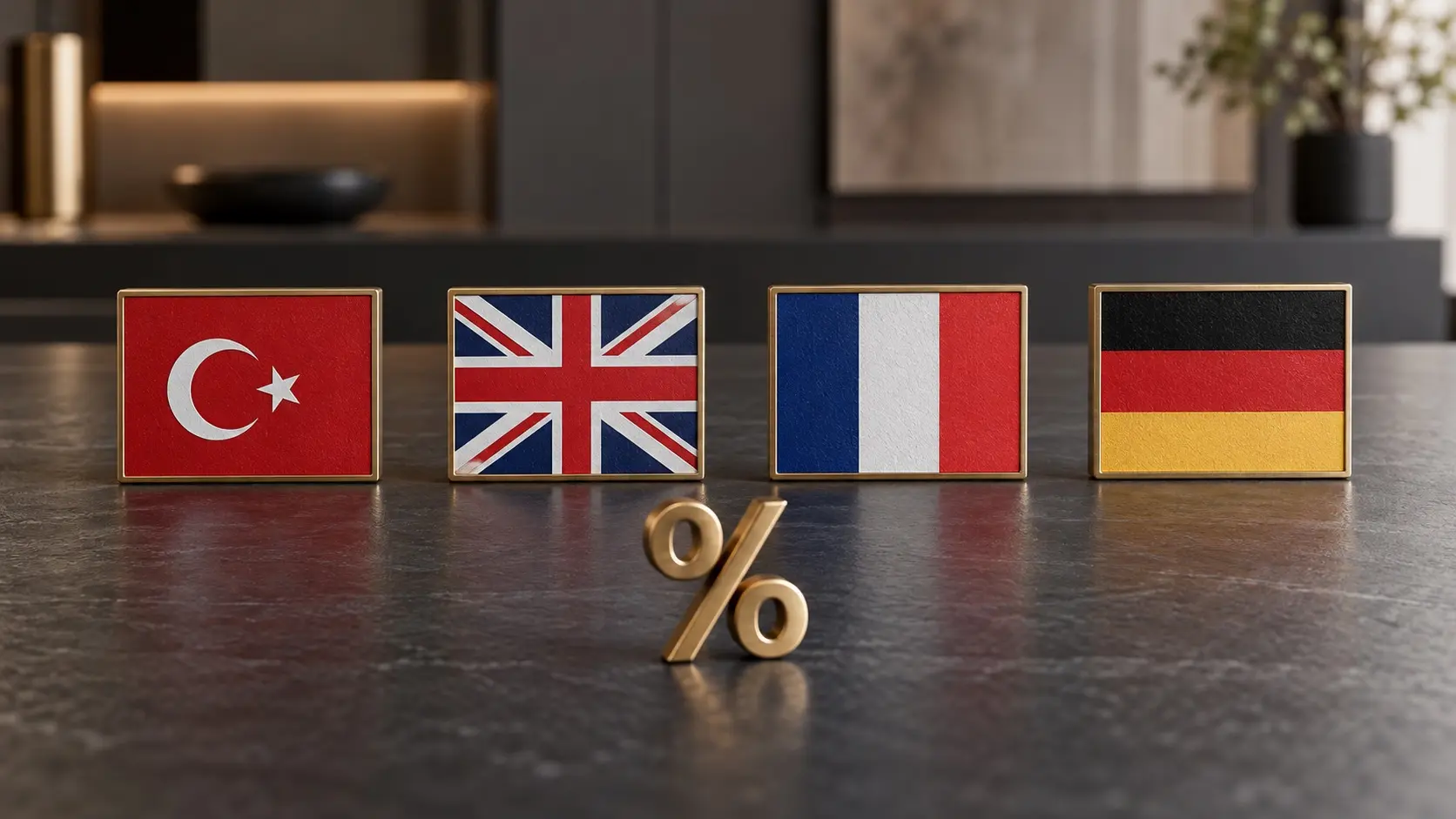
Turkey's top inheritance rate is 10%, or 1% under the Article 20/D route, against headline top rates of 40% in the UK, up to 45% in France, and up to 50% in Germany depending on the heir's relationship. Those rates overstate what many families pay after allowances, but the gap is wide.
The bigger point is that a passport rarely changes your home-country exposure. Inheritance tax follows where you live, your domicile, and where your assets are located. A second passport from a country with no inheritance tax doesn't remove the tax your country of residence applies.
Turkish citizenship adds a Turkish layer. Foreign inheritance tax is deductible against it, and for families who move their tax residence to Turkey, the 1% route can replace a far heavier regime. Compare the combined picture, not one passport in isolation.
6. Does a Passport Change my Income Tax?
No. Turkish income tax follows residence, not nationality. Residents, meaning those domiciled in Turkey or living there continuously for more than six months in a calendar year, are taxed on worldwide income. Non-residents are taxed on Turkish-source income only. Holding a Turkish passport while living elsewhere doesn't create a Turkish income tax bill.
That is different from the citizenship-based model a few countries use, the United States being the best known. Turkey uses nationality as a hook in one place: this inheritance and gift tax.
If you do become resident, Article 20/D can exempt qualifying foreign-source income for 20 years. Turkish-source income, such as rent from Turkish property, stays taxable.
7. What Should I Ask Before Committing?
Six questions separate a plan from a hope. Put them to any adviser, including us:
1. Which country will my family be tax resident in after naturalisation, and does that meet the Article 20/D conditions, including the clean three-year record and the exemption certificate deadline?
The tax exists, and it is manageable. Your heirs, not you, pay it. The ordinary scale tops out at 10%, foreign tax paid is deductible, and qualifying new residents pay a flat 1% if death falls within 20 years.
The risk isn't the tax. It's an unplanned structure: the wrong residency, the wrong timing, a missed certificate deadline, no Will. Settle those before you apply, not after.
If you're considering Turkish citizenship by investment, speak to the Property Turkey team. We'll walk you through the options and connect you with qualified cross-border tax and legal advisers before you commit.
Sources and Legal References
- Figures are as of 31 October 2026.
- Law No. 7338, Inheritance and Transfer Tax Law, Articles 1, 12, and 16
NOTE: This article is general information, not tax, or legal advice. Rules are new and their application is still developing, and thresholds are revalued each year, while Dollar equivalents move with the exchange rate. Take qualified cross-border tax and legal advice before making any decision.
Cameron Deggin Founder & CEO, Property Turkey
Cameron Deggin is Founder and CEO of Property Turkey. A former finance professional and FCCA-qualified accountant, he founded the company in 2001 after recognising Turkey’s investment potential. With more than two decades analysing Turkish real estate, Cameron regularly advises international investors and is quoted by media including the Financial Times and BBC.




 By:






 Founder & CEO, Property Turkey

 Bodrum
 4
 4

















 X