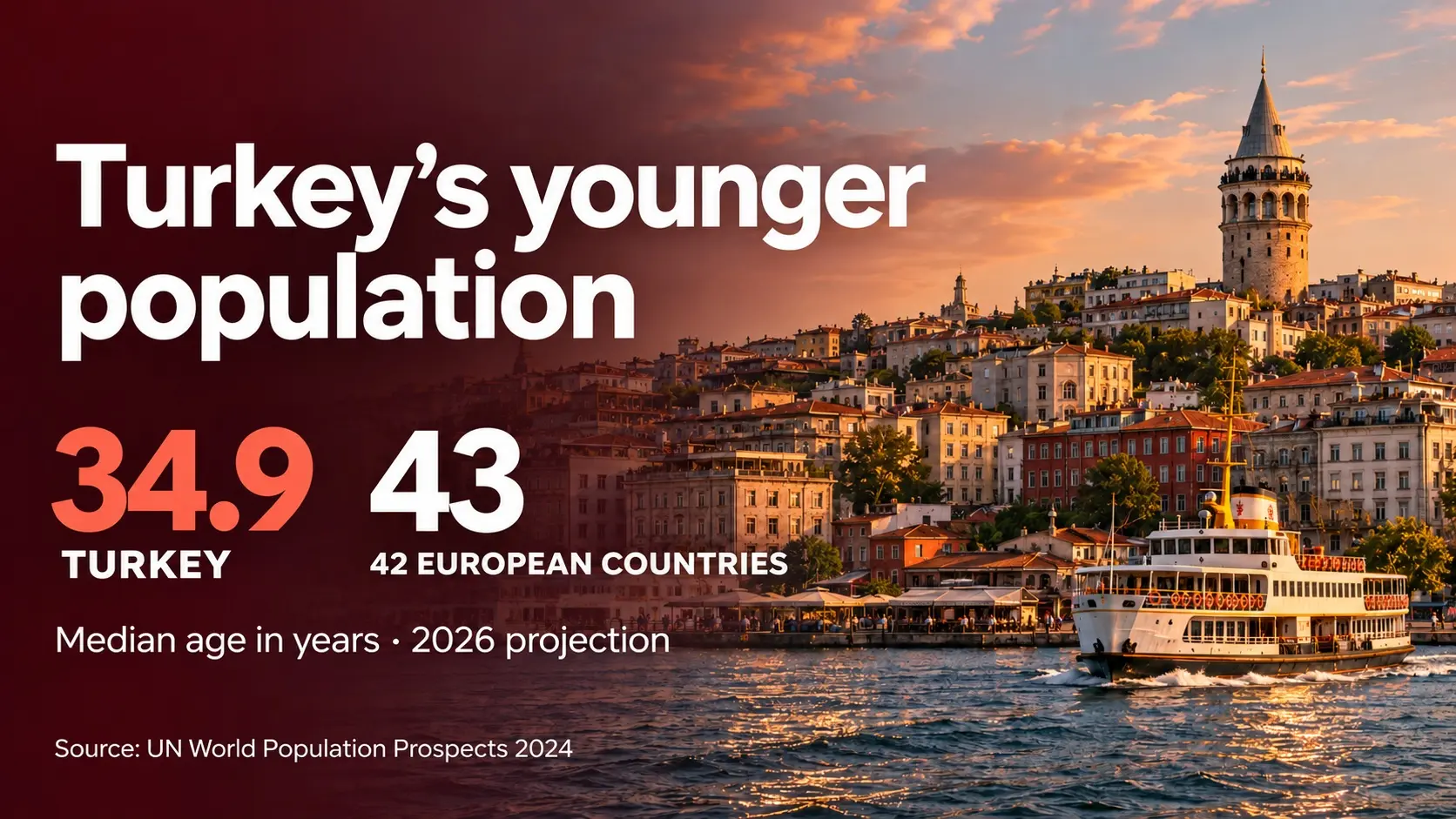
Across the 42 European countries in the UN chart we keep coming back to, the median age in 2026 is 43, and Turkey sits at the young end. For an investor thinking in 10 to 15 year horizons, that gap is where our case for city-centre Istanbul begins.
Europe Is Old, Turkey Is Not: The Age Curve in Numbers
The UN World Population Prospects 2024 puts the median age of the 42 European countries in the chart at 43 years in 2026. Its medium-variant projection for Turkey in 2026 is 34.9 years, roughly eight years younger.
TurkStat counts 14.8% of the population, about 12.7 million people, as young (aged 15 to 24) in 2025. These are the people who will form households, rent their first flats and, in time, take out their first mortgages over the next decade and a half.
Households tell the same story. TurkStat counted 26.98 million households in 2025, of which 5.52 million, or 20.5%, were one-person households, up from 14.9% in 2016. Smaller households mean more homes are needed for the same population.
Indicator
Figure
Date
Source
Median age, 42 European countries
43 years
2026
UN World Population Prospects 2024
Turkey median age (medium-variant projection)
34.9 years
2026
UN World Population Prospects 2024
Population aged 15 to 24
14.8%, about 12.7 million
2025
TurkStat
Households
26.98 million
2025
TurkStat
One-person households
5.52 million (20.5%)
2025
TurkStat
Istanbul population
Over 15 million (about 18.3%)
2025
TurkStat Address Based Population Registration System
From Demographics to GDP and Innovation: Closing the Gap
A young population only lifts property values if incomes rise with it. The European Commission Turkiye Report 2026 puts Turkey's GDP per capita in purchasing power standards at 69.1% of the EU-27 average in 2024. That is a gap, and also room to close.
The IMF DataMapper estimates Turkey's GDP per capita in 2026 at $21,080 USD nominal and $46,680 USD at purchasing power parity (October 2026 World Economic Outlook). On 13 February 2026, the IMF Article IV consultation projected real growth of 4.2% in 2026 and about 4.0% a year from 2027 to 2031. To be precise, the IMF does not forecast parity with Europe by 2030, and it flags persistent inflation and the need for productivity reforms as risks. Our argument is about direction over 10 to 15 years.
- R&D: TurkStat's survey, released 30 October 2026, put gross domestic R&D spending at 980.4 billion TL in 2025, 1.55% of GDP, up from 1.46% in 2024.
- Patents: TURKPATENT reports 11,394 domestic patent applications in 2025, 12% more than in 2024.
- High-tech exports: about $9.9 billion USD in 2025, according to TurkStat figures reported by Anadolu Agency.
- Venture capital: the Ministry of Industry and Technology's Year in Review 2025 counts $589 million USD across 306 deals in 2025, and six Turkish ecosystem unicorns.
TurkStat's address-based register put Istanbul's population at over 15 million in 2025, about 18.3% of the country. In October 2026, TurkStat's house sales statistics recorded 22,753 home sales in Istanbul, of which 7,402 were first-hand. Nationally, 131,072 homes sold that month, so Istanbul accounted for roughly one sale in six.
Why do we rank young local buyers above foreign demand? In earlier posts we reported that foreign buyers took 21,535 homes in 2025, 1.3% of sales nationwide, and 1.5% of transactions in September 2026. Domestic households set prices; foreigners join a market that locals already support.
The Mortgage Reset: Why First-Time Buyers Could Double or Triple
Mortgages are the missing piece. TurkStat data for October 2026 shows 23,286 mortgage-financed sales, down 5.7% year on year and just 17.8% of all sales. The Central Bank's November 2020 Financial Stability Report puts the share at 33.5% in 2016, 33.6% in 2017 and about 40% in 2013.
The depth gap is wider still. The European Mortgage Federation's Hypostat 2025 puts outstanding residential mortgage loans at 1.3% of GDP in Turkey in 2023, against 42.3% for the EU-27. These are balances outstanding, not annual lending.
The BDDK decision of 29 January 2026 caps loan-to-value by price and energy rating. For homes valued up to 5,000,000 TL, the cap is 90% for energy class A-B, 80% for C and 70% for other classes. It also removed the first-hand and second-hand distinction.
- In Committee: A TBMM bill offering state interest or profit-share support for first-time buyers, with financing up to 120 months, was still in parliamentary committee as of 28 November 2026. Sources differ on the age limit (under 36 or under 40). It is not law.
- Discussed Only: On 21 January 2026 the Financial Stability Committee, chaired by Mehmet Simsek, said it had discussed mortgage restrictions for first-time buyers (Ministry of Treasury and Finance). No term or deposit rule was announced.
- Social Housing: The deposit and term headlines around TOKI belong to the government's social housing campaign, not to a general mortgage.
Our projection, not a forecast: we expect a new mortgage system within a few years. If the mortgage share returned to its 2016-2017 level of about 33.5% on October 2026 volumes, mortgage sales would roughly double.
Tripling needs more: a share back towards the roughly 40% of 2013 plus a recovery in total sales, which fell 23.3% year on year in October 2026. Both depend on continued disinflation and rate cuts. If those stall, so does this timeline.
Restricted Supply in City Centres and Urban Regeneration
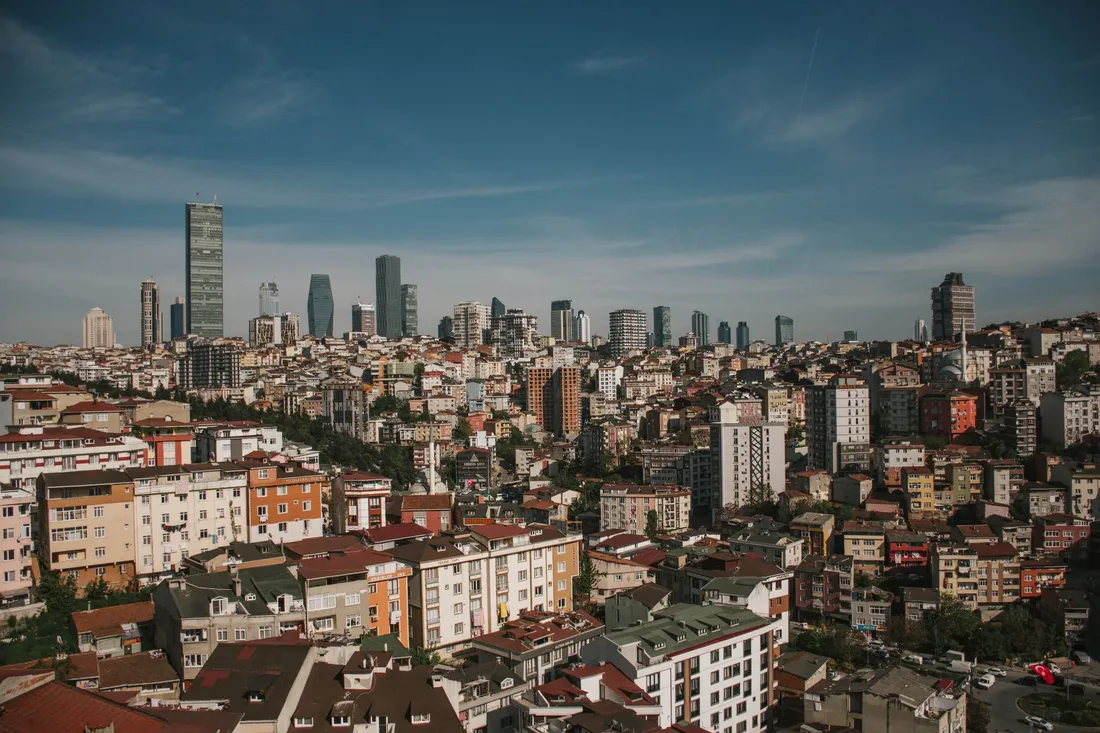
Central districts such as Sisli, Besiktas, Kadikoy, Bakirkoy, and Zeytinburnu are largely built up. Istanbul's 1:100,000 environmental plan, approved in 2009 and still in force, protects forest, agricultural, and water-basin land and prohibits construction in water basins.
That leaves regeneration as the main source of new central homes. In its November 2023 budget presentation, the Ministry of Environment, Urbanisation and Climate Change estimated about 1.5 million at-risk independent units in Istanbul, 600,000 of them needing urgent transformation.
These are renewal estimates, not a count of missing homes, and should not be added to household demand. Renewal mostly replaces old stock plot by plot, which keeps central supply slow and costly, as we explain in why Istanbul's urban regeneration property suits first-time investors.
National completions are not surging either. TurkStat building permit statistics show apartments receiving occupancy permits rose 3.1% year on year in Q4 2025. That figure does not show where completions are or whether they are affordable, so we work district by district.
Why Affordable City Centre Beats the Periphery and Luxury
The table uses median asking prices per net square metre on Property Turkey's live listings on 28 November 2026: asking prices, not sale prices.
District
Median asking price per net m2
Listings
Besiktas
$8,164 USD
33
Sisli
$4,632 USD
68
Eyup
$3,842 USD
43
Beyoglu
$3,627 USD
50
Kagithane
$3,143 USD
65
Beylikduzu
$2,068 USD
43
Esenyurt
$1,653 USD
10 (medium reliability)
Outer districts such as Beylikduzu on the western edge and Esenyurt on the European Side are cheaper per square metre, but they have more developable land and larger pipelines. New supply can dilute price performance even when demand is healthy. Luxury, at the Besiktas end, relies on a thin pool of wealthy buyers. Affordable central districts such as Kagithane, Beyoglu, Eyup, and parts of Sisli sit where young salaried households want to live and where land is scarce.
The BDDK rules point the same way: the most generous loan-to-value caps apply to energy-efficient homes valued up to 5,000,000 TL, so the deepest financing reaches affordable homes rather than the top end. Some central opportunities reach buyers privately through Property Turkey First Access.
Real prices are falling now. The Central Bank of Turkey RPPI for September 2026 shows Turkey up 22.3% nominal year on year but down 5.7% after CPI inflation. Istanbul rose 26.8% nominal; no separate real figure for the city is published.
- Weak Sales: Total home sales fell 23.3% year on year in October 2026 (TurkStat), and mortgage sales fell 5.7%.
- Policy Timing: The first-time buyer bill is still in committee, and nothing guarantees it passes or on what terms.
- Inflation: The IMF flags persistent inflation and slow productivity reform; either could delay rate cuts and our mortgage timeline.
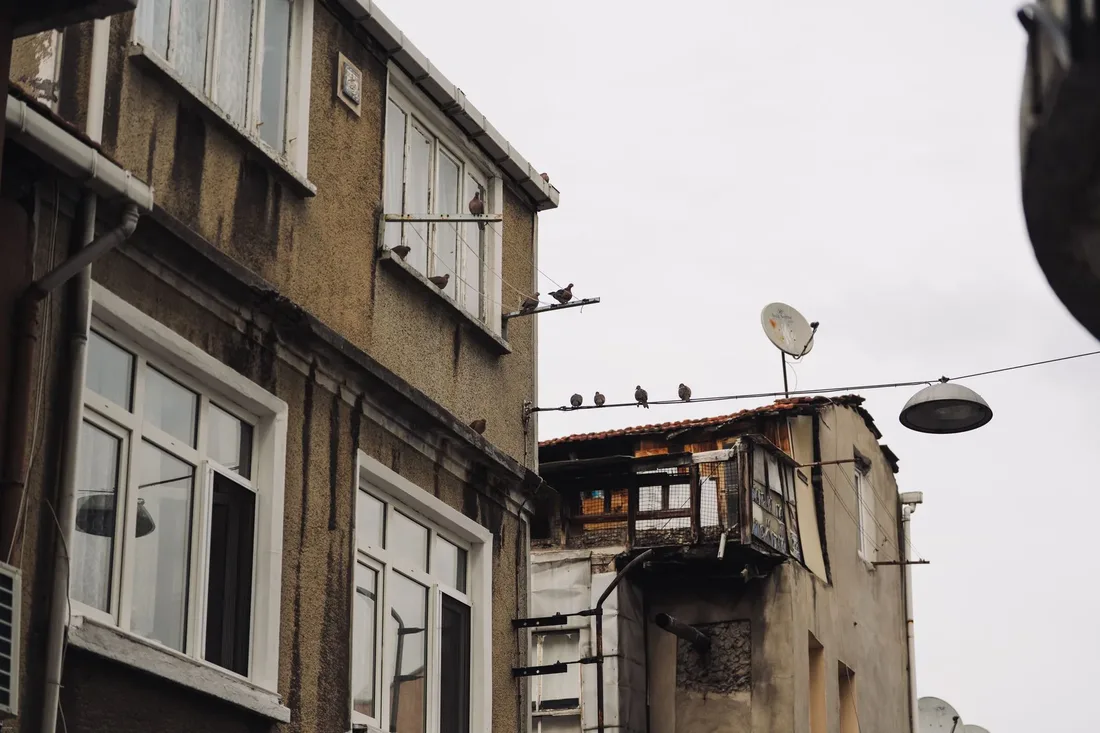
- Building Quality: Older central stock carries structural risk, so we check building age, permits and renewal status before any purchase.
Demographics also move slowly, and Turkey is ageing too. The young advantage is a 10 to 15 year tailwind, not a quick trade, and Lira volatility can hurt returns measured in Dollars or Euros along the way.
What This Means for Investors, With Caveats
Property Turkey has helped international buyers invest in Turkey since 2001, from property search and legal checks to management and resale. Our house view, stated as a view and not a guarantee, is affordable city-centre Istanbul held directly for 10 to 15 years. To test it against your budget, contact us. If citizenship is part of your plan, read Turkish Citizenship in 2027: More Than a Passport? before choosing a district.
FAQs: Young Turkey and Istanbul Property
Q: What is Turkey's median age compared with Europe?
A: The UN World Population Prospects 2024 medium-variant projection puts Turkey's median age at 34.9 years in 2026, against a median of 43 across 42 European countries.
Q: Is a 25-year, 10% deposit mortgage now law in Turkey?
A: No. What is in force is the BDDK decision of 29 January 2026 on loan-to-value caps. A first-time buyer support bill was still in parliamentary committee as of 28 November 2026.
Q: Will mortgage-financed sales really double or triple?
A: That is our projection, not a forecast. Doubling assumes the share returns from 17.8% (October 2026) to about 33.5%; tripling also needs total sales to recover. Both depend on disinflation and rate cuts.
Q: Why city centre rather than cheaper outer districts?
A: Outer districts have more developable land and larger pipelines that can dilute price performance. Central districts are largely built up, so new supply comes slowly through regeneration.
Q: Are Turkish house prices rising in real terms?
A: Not at present. The Central Bank index shows prices up 22.3% nominal but down 5.7% after inflation in September 2026.
Q: Should I buy directly or through a fund?
A: Our view favours direct ownership of affordable city-centre Istanbul homes. A fund is a different product with different risks, so compare both with your adviser.
Cameron Deggin
Founder & CEO, Property Turkey
Cameron Deggin is Founder and CEO of Property Turkey. A former finance professional and FCCA-qualified accountant, he founded the company in 2001 after recognising Turkey’s investment potential. With more than two decades analysing Turkish real estate, Cameron regularly advises international investors and is quoted by media including the Financial Times and BBC.


 By:


 Founder & CEO, Property Turkey
 Istanbul
 3
 2






 Property Enquiry









 X