October 2026 at a Glance
- Annual Inflation: In October, the inflation rate fell to 29.77%, reaching its lowest level in the past four years. By the end of the year, inflation is expected to stand between 24% and 29.5%.
- Policy Rate: The Central Bank of the Republic of Turkey (CBRT) reduced its policy rate by 100 basis points, bringing it down from 37% to 36%, as part of its gradual monetary easing process amid the ongoing decline in inflation. Looking ahead, the CBRT is expected to maintain its cautious approach while continuing to adjust monetary policy in line with inflation developments. Market expectations point to a further 100-basis-point interest rate cut by the end of 2026, which could bring the policy rate down to 35%.
- Real Estate Sales: 131,072 residential properties were sold across Turkey in October. Istanbul, Ankara, and Izmir stood out as the cities with the highest numbers of sold units. Compared with the same period last year, sales volume decreased by 23.3%. As a result, total residential property sales across Turkey reached 1.223 million units in the first ten months of the year.
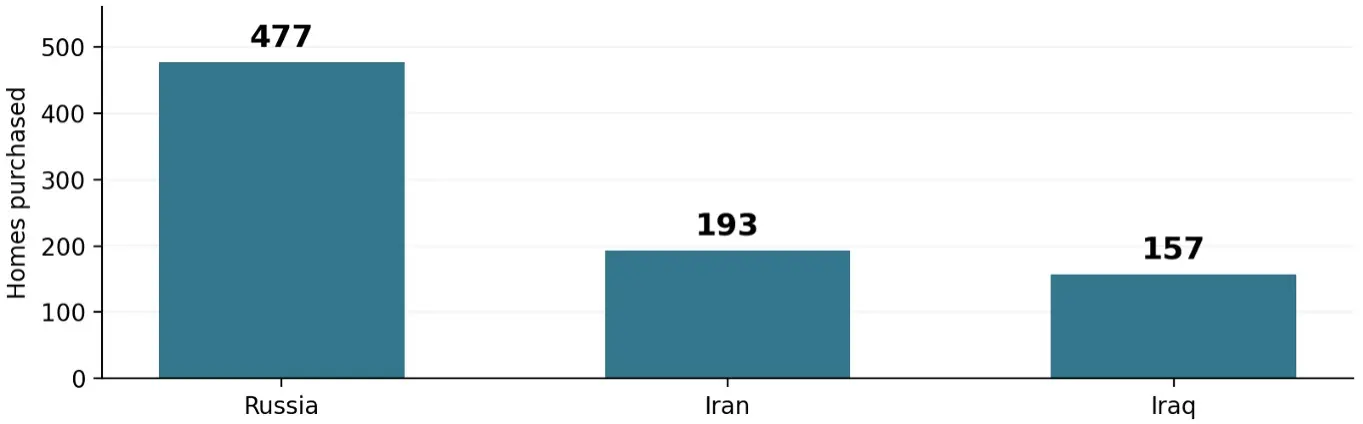
- Foreign Sales: In October, foreign buyers purchased 2,259 residential properties across Turkey. Russian, Iranian, and Iraqi citizens were among the top foreign buyers. Compared with October last year (2,238 units sold) foreign investment in residential properties increased by 0.93%, while the nationalities of the top foreign homebuyers remained largely similar. By the end of the year, a higher number of foreign investors are expected to invest in the Turkish real estate sector compared with last year.
- Property Price Movements: In USD terms, housing prices in Ankara recorded a monthly increase of 0.09% in October. In contrast, Istanbul and Izmir experienced declines of 0.58% and 2.25%, respectively, in residential property prices.
- TRY / USD: The US Dollar exchange rate, which stood at TRY 48.95 at the beginning of the month, rose to TRY 49.77 by the end of October. The Turkish Lira depreciated by 1.69% against the US Dollar monthly.
- Exchange Reserves: In October, the Central Bank of the Republic of Turkey’s (CBRT) foreign exchange reserves fell from $167.36 billion USD to $158.11 billion USD. This decline was attributed to falling gold prices and increased foreign currency demand amid the fund crisis.
Turkey’s Economic Performance
In October, the IMF, the World Bank, and the EBRD issued a series of assessments regarding the Turkish economy. While the IMF projected economic growth of 2.7% for 2026, it emphasised that energy prices continued to pose a significant risk. The World Bank highlighted the slowdown in the disinflation process and stressed the need to maintain a tight monetary policy stance. Meanwhile, the EBRD noted that high inflation was weakening domestic demand and increasing cost pressures on exports. 1, 2, 3, 4
Tourism revenues reached $51.27 billion USD in the first nine months of the year, while the total number of international visitors approached 48 million. By the end of the year, tourism revenues are expected to exceed $60 billion USD, with the number of visitors projected to reach 60 million. Meanwhile, the national unemployment rate stood at 8.4%, while total employment amounted to approximately 32.5 million people (Table 1). 5
Table 1. Turkey’s Economic Indicators: October vs September 2026
| Indicator |
October |
September |
| Annual GDP Est. (T-$) |
1,820 |
1,820 |
| Annual GDP Growth (%) |
2.7% |
2.3% |
| Inflation (%) |
29.7% |
29.8% |
| CBRT Interest Rate (%) |
36.0% |
37.0% |
| USD/TRY |
49.77 |
49.1 |
| EUR/TRY |
55.75 |
55.2 |
| GBP/TRY |
66.84 |
65.0 |
| Unemployment Rate (%) |
8.4% |
7.8% |
| Current Account (Billion $) |
-39.2 |
-41.2 |
| Credit Rating (S&P) |
BB- |
BB- |
Source: CBRT and IMF

Political Outlook and Election Expectations
Politically, a month marked by growing anticipation of early elections has come to an end. The general elections are expected to take place around the first quarter of 2028, followed by local elections in March 2029. The upcoming elections are not expected to have a negative impact on economic expectations or inflation. 6
Turkey’s Property Market: Sales and Prices
In October, total housing sales reached 131,072 units. The housing market was mostly driven by cash sales (82.2% in cash). Most investors exiting interest-bearing deposits purchased housing, becoming real estate investors. Compared with the same month last year, the share of foreign investors in total residential property sales increased from 1.3% to 1.7%. Accordingly, a total of 17,567 units were purchased by foreign buyers during the first ten months of the year (Table 2). 7
Table 2. Home Sales to Foreign Buyers: January to October 2026 vs 2025
| Month |
2026 Sales |
2026 Share (%) |
2025 Sales |
2025 Share (%) |
| October |
2,259 |
1.7% |
2,238 |
1.3% |
| September |
2,167 |
1.5% |
1,972 |
1.3% |
| August |
1,938 |
1.5% |
1,936 |
1.3% |
| July |
2,120 |
1.7% |
2,081 |
1.3% |
| June |
2,015 |
1.6% |
1,678 |
1.4% |
| May |
1,387 |
1.5% |
1,900 |
1.5% |
| April |
1,516 |
1.2% |
1,533 |
1.2% |
| March |
1,353 |
1.2% |
1,692 |
1.5% |
| February |
1,506 |
1.2% |
1,551 |
1.3% |
| January |
1,306 |
1.2% |
1,649 |
1.4% |
| TOTAL |
17,567 |
1.4% |
18,230 |
1.3% |
Source: TÜİK

Chart 1. Top Three Foreign Buyer Nationalities: October 2026
Source: TÜİK
Istanbul was the city where foreigners purchased the most homes during the month, followed by Antalya and Mersin. Sales in Istanbul showed a slight decrease compared to the same month of last year. It is estimated that foreign investors invested over $3.3 billion USD in the housing sector across Turkey in the first ten months (Table 2 and Chart 1).

Table 3. Home Sales to Foreign Buyers by City: October 2026
| City |
Homes sold to foreigners |
Foreign sales share (%) |
| Istanbul |
898 |
3.94% |
| Antalya |
752 |
12.07% |
| Mersin |
153 |
4.00% |
Source: Endeksa
In October, foreign investors accounted for 12.07% of residential property purchases in Antalya, while this figure stood at 3.94% in Istanbul and 4.00% in Mersin. Over the first ten months of the year, foreign buyers accounted for 1.4% of total residential property sales, representing an increase in their share compared with the same period last year (Tables 2 and 3). 8
While real estate prices recorded an annual increase of 1.97% in USD terms as of October 2026, they experienced a monthly decline of 0.97% in October. At the metropolitan level, Ankara was the exception, maintaining positive price growth in USD terms, while Istanbul and Izmir recorded declines. This divergence highlights the differing dynamics across Turkey’s major housing markets, with Ankara demonstrating greater resilience compared to the other two metropolitan areas (Tables 3 and 4). 9

Table 4. Property Price Changes in USD: October 2026
| Change (%) |
Turkey |
Istanbul |
Ankara |
İzmir |
| Annual |
+1.97% |
+4.47% |
+3.29% |
-0.75% |
| Monthly |
-0.97% |
-0.58% |
+0.09% |
-2.25% |
Source: CBRT
NOTE: All figures represent an increase or decrease in USD.
Key Developments in October
Investment Fund Investigations and Market Impact
The fund crisis in Turkey has triggered a major investigation into the country's financial markets, leading to a series of high-profile arrests and resignations. Several former and senior officials, including a former minister and members of parliament, have been detained, while the heads of the Capital Markets Board (CMB), Takasbank, and Borsa Istanbul have also been arrested. Meanwhile, the head of the Banking Regulation and Supervision Agency (BRSA) has resigned. As part of the compensation and restitution process, approximately $3.2 billion USD has been paid to investors. So far, 333,000 investors have recovered their investments in full, while the repayment process for another 111,000 investors is still ongoing. These developments highlight the scale of the crisis and its significant implications for Turkey's financial system, capital markets, and investor confidence.

Property Turkey’s Outlook for Property Buyers
October presented investors with a mixed picture. Annual inflation stood at 29.77%, while the Central Bank continued its easing cycle by cutting the policy rate to 36%. However, as disinflation slows, we consider the lower end of year-end inflation forecasts overly optimistic.
In the real estate market, the key issue is real rather than nominal growth: nationwide house prices increased by 21.1% in Lira terms but declined by 6.6% after adjusting for inflation. In Istanbul, prices rose by 24.8%, while rents for new tenants increased by approximately 31%, indicating that rental income is outperforming capital appreciation.
Meanwhile, home sales fell by 23.3% year on year, and 82.2% of transactions were cash purchases, supporting the view that the market currently favours buyers with sufficient liquidity and strong negotiating power. Foreign demand remains steady rather than surging, with October purchases increasing by 0.9%, although the cumulative figure for the first ten months declined by 3.6%. The higher foreign-buyer share of 1.7% primarily reflects the contraction in the domestic market rather than a significant increase in international demand.
The fund crisis has also provided an important lesson for investors: before investing in any fund, it is essential to understand its underlying assets, valuation mechanisms, and custody arrangements.
Our investment approach is therefore straightforward: buy below market value, prioritise rental income, and avoid relying on nominal gains driven by Lira depreciation or inflation. In the current environment, selectivity matters more than speed.
On the macroeconomic outlook, the IMF and OECD project Turkey's 2026 economic growth at 2.7%, while the EBRD forecasts 3.0%. Regarding sovereign credit ratings, S&P and Fitch assign Turkey a rating of BB-, while Moody's maintains its rating at Ba3.

Sources
1. European Bank for Reconstruction and Development (EBRD).
2. IMF, “World Economic Outlook”, October 2026.
3. World Bank, “Macro Poverty Outlook: Turkey”, October 2026.
4. EBRD, “Regional Economic Prospects”, October 2026.
5. Turkish Statistical Institute (TURKSTAT).
6. Rosaleen Carroll, “Turkey’s Erdoğan to Run For Final Third Term in 2028”, AL-MONITOR, September 2026.
7. Turkish Statistical Institute (TURKSTAT).
8. Turkish Statistical Institute (TURKSTAT).
9. “Real Estate Price Index”, TCMB, October 2026.
10. All figures represent an increase or decrease in USD.

Cameron Deggin  Founder & CEO, Property Turkey
Cameron Deggin is Founder and CEO of Property Turkey. A former finance professional and FCCA-qualified accountant, he founded the company in 2001 after recognising Turkey’s investment potential. With more than two decades analysing Turkish real estate, Cameron regularly advises international investors and is quoted by media including the Financial Times and BBC.
View full author profile →




 By:


 X