In Short: Turkey's new Investor Residence Permit gives non-working foreign investors and their families three years for $150,000 USD or five years for $200,000 USD, invested in Turkish bank deposits, government bonds, real estate or venture capital fund units, or private pensions, and held for 18 or 30 months. Buying a home directly does not qualify, and the permit does not lead to citizenship. On our 2027 projections, a real estate investment fund is the strongest route in US Dollar terms.
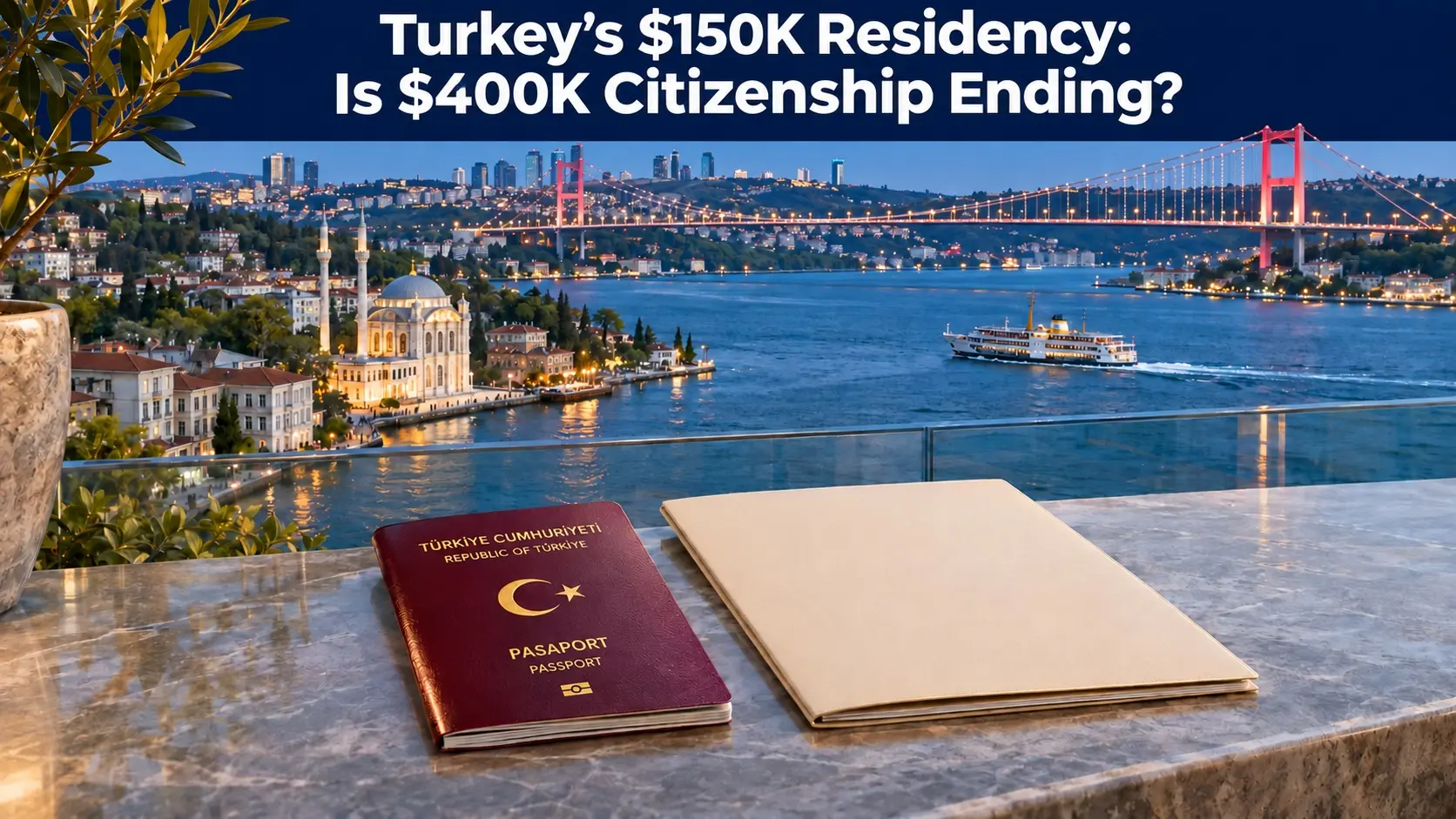
If Turkish citizenship is on your list, do not wait. On 18 November 2026 Turkey opened a new, cheaper door to living in the country: a residence permit for $150,000 USD (three years) or $200,000 USD (five years). In the same decision it deliberately shut that door off from citizenship. In our view this is the clearest signal yet that Turkey is building two separate paths, one for residency and one for the passport, at very different prices. We expect the citizenship path to become far more expensive, or to close altogether, before the 2028 elections. If you want citizenship by investment, the time to act is now, under today's rules.
The New Investor Residence Permit at a Glance
3-year Permit
5-year Permit
Minimum investment
$150,000 USD
$200,000 USD
Minimum holding period
18 months
30 months
Who is covered
Investor, spouse, minor or dependent children
Same
Right to work in Turkey
No
No
Leads to citizenship
No (Article 4)
No (Article 4)
Qualifying investments
Bank deposits, government debt, real estate or venture capital fund units, private pension
Same
Direct property purchase
Does not qualify
Does not qualify
Source: Presidential Decision No. 11994, signed 17 November 2026 and published in Official Gazette No. 33434 on 18 November 2026, in force immediately.
What Exactly has Turkey Introduced?
Presidential Decision No. 11994 creates a residence permit for foreign investors who do not work in Turkey. Invest $150,000 USD in a qualifying Turkish product and you receive a three-year permit; invest $200,000 USD and you receive five years. Your spouse and your minor or dependent children are included.
The money must stay invested for at least half the permit term: 18 months for the three-year permit and 30 months for the five-year permit. Each type of investment is monitored by its own regulator.
Two points are crucial. First, buying a home does not count: the existing property-based short-term permit stays separate, and the current application form requires the home to be worth at least $200,000 USD and not rented out. Second, Article 4 of the decision states that these permits do not count towards exceptional citizenship under Article 12 of the Turkish Citizenship Law.
Which Investments Qualify: What Could Each Return in 2027?
There are four qualifying channels. We have projected a net 2027 return in US Dollars for each, after Turkish withholding tax and allowing for the expected fall of the Lira.
Route
Projected 2027 Net Return in USD
How We Got It
Real estate investment fund (GYF), e.g. Funding Turkey
8.0%
Funding Turkey's target of 8% net-net rental income, before any capital growth. Gains are taxed at 0% once units are held over 2 years, which the five-year permit's 30-month hold covers
Turkish Lira government bonds
5.0%
31% yield minus 10% withholding gives 27.9% net in Lira, converted to USD. Bought by 31 December 2026, withholding is 0% and the projection rises to 7.5%
Turkish Lira bank deposit (12 months)
3.7%
31% interest minus 15% withholding gives 26.35% net in Lira, converted to USD
Private pension (BES, Lira)
3.7%, before fund charges
The same Lira return as deposits, minus 15% tax on exit before 10 years. Foreigners do not receive the 20% state contribution
US Dollar bank deposit
2.2%
2.90% average rate minus 25% withholding
Our Assumptions: The US Dollar rises from 51.50 Lira at the end of 2026 to 62.75 at the end of 2027, the midpoint of ING's EMEA FX Outlook 2027, a Lira fall of about 21.8%. The Central Bank's Market Participants Survey expects the policy rate to fall from 34.3% in January 2027 to 28.19% by year end; we used a 31% average Lira yield.
Important: These are projections, not guarantees. The Lira routes depend almost entirely on the exchange rate: if the Lira weakens about 5 points more than ING expects, the three Lira routes fall to roughly zero in Dollar terms.
Bank Deposits: Safe on Paper, Thin in Dollars
A 12-month Lira deposit looks generous at headline rates, but after 15% withholding and the Lira's expected fall, our projection is 3.7% in Dollars. A US Dollar deposit is projected at 2.2% after 25% withholding. For money that must sit still for 18 or 30 months, that is a lot of time for very little.
Government Bonds: Better, With a Short Window
Lira government bonds project at 5.0% in Dollars. Buy before 31 December 2026, while withholding is 0%, and the projection rises to 7.5%. The same currency risk applies.
Private Pensions (BES): The Weakest Fit for Foreigners
A pension shares the deposit-level Lira return, adds a 15% exit tax before 10 years, and carries fund charges. Foreign participants also miss out on the 20% state contribution that Turkish savers receive. We project 3.7% before charges.
Real Estate Investment Funds: The Only Route Backed by Real Property
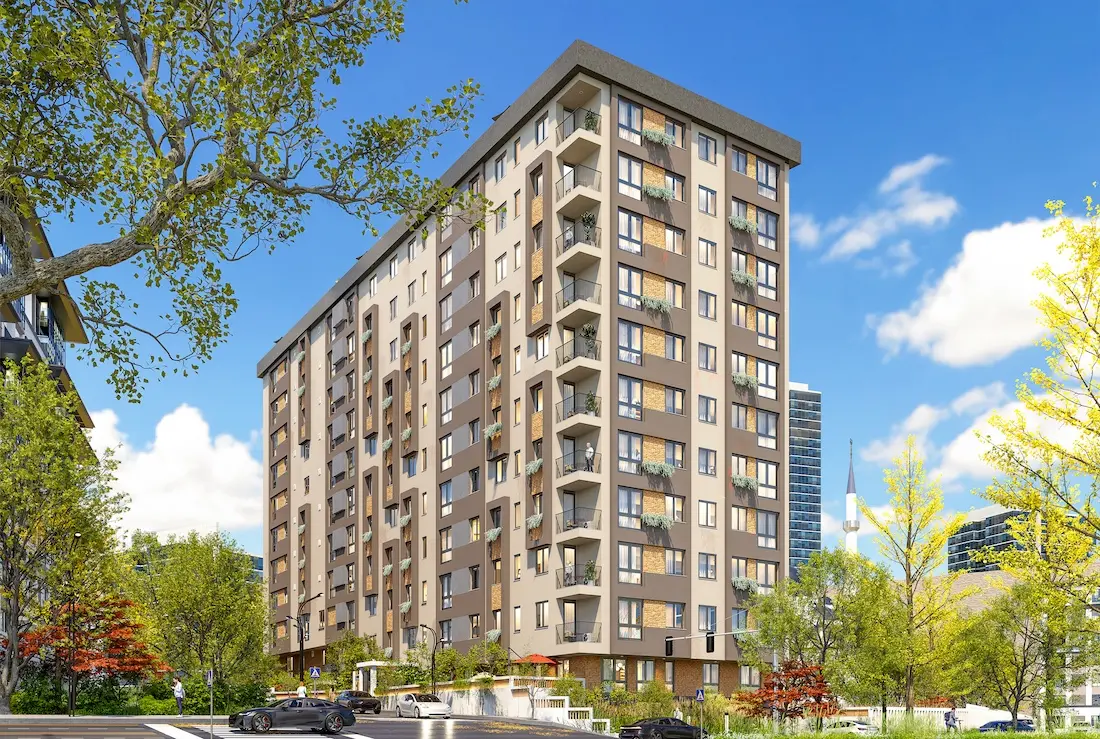
A real estate investment fund (GYF) is the only qualifying route that keeps your money in bricks and mortar. You own units in a regulated fund that owns and lets property; you do not own the property directly. Funding Turkey, the fund arm of Property Turkey Group, works under Capital Markets Board (SPK) law and focuses on affordable city-centre Istanbul homes suited to long and short-term lettings.
Funding Turkey's target is 8% a year net-net from rental income alone, before any capital growth. Our view is that, with capital growth on top, total returns in US Dollar terms could be meaningfully higher, potentially up to double the income target, though this is a projection and not a promise. And because units held over two years pay 0% tax on gains, the 30-month hold of the five-year permit sits neatly inside that window.
Why Did Turkey Introduce This Permit?
The government has not published an official reason; the decision contains no statement of purpose. Reading its design against the 2026 data, four motives stand out:
1. Hard Currency that Stays Put: Every qualifying channel is financial, and the money is locked in for 18 or 30 months. Turkey's current account deficit for January to September 2026 was $27.96bn USD, against $19.10bn USD a year earlier.
2. A New Offer as Foreign Home Buying Slows: House sales to foreigners fell to 21,534 in 2025, a nine-year low against a 2022 peak of 67,490, and were down a further 4.3% in January to September 2026, according to TurkStat data.
3. The Residence Half of the 2026 Investor Package:Law No. 7582, published on 4 June 2026, gives people who become Turkish tax residents from 1 January 2026 a 20-year exemption from Turkish tax on their foreign income. Those people need a legal way to live in Turkey without working. This permit provides it.
4. Keeping the Passport Separate: Article 4 ring-fences citizenship. That is the part that we think is the most important.
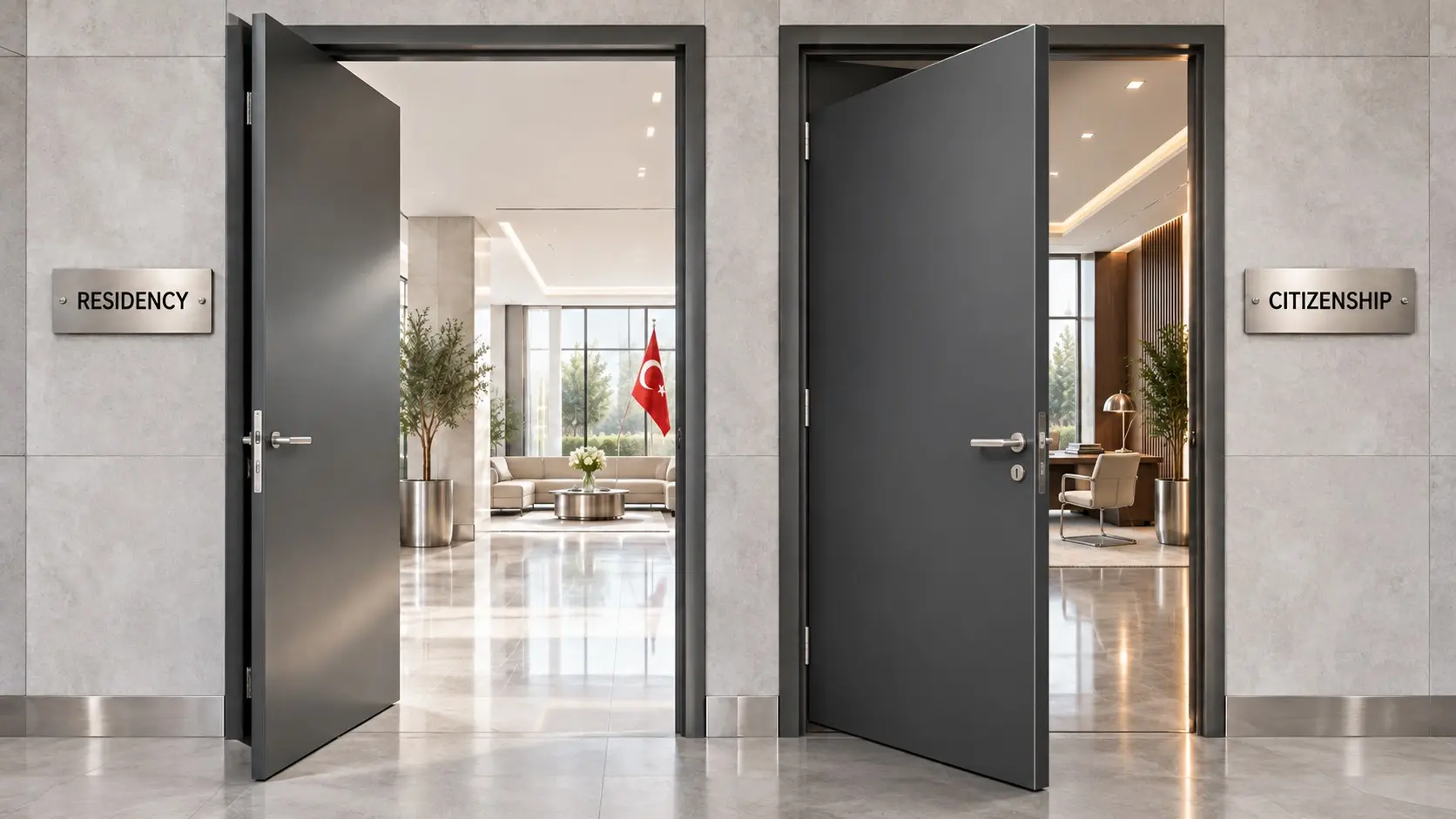
Our View: Two Paths, and the Citizenship Door is Narrowing
Turkey's Citizenship by Investment Programme began in January 2017 at $1 million USD for property. It was cut to $250,000 USD in September 2018 and raised to $400,000 USD in June 2022. Today a citizenship investment through funds requires $500,000 USD held for three years.
The programme became a political target in the 2023 campaign. Opposition leader Kemal Kılıçdaroğlu attacked it as effectively putting Turkish citizenship up for sale for a $400,000 USD home and pledged to repeal citizenship through property purchase. Three years on, the race is tight: a November 2026 poll average puts the AK Party at 27.4% and the New Party at 25.6%, with the next elections due in 2028.
Now look at what the government has just done. It has created a well-priced, long-term way for foreign investors to live in Turkey, and in the same text blocked it from leading to a passport. Residency is being made easier; citizenship is being kept apart. Once a credible residency option exists, the political cost of making citizenship much harder falls sharply.
Our expectation, and it is our opinion rather than an announced policy, is that before the 2028 elections the government will either abolish citizenship by investment altogether or raise the threshold sharply, possibly back to the original $1 million USD. Rules in Turkey can change by presidential decision with little notice, as 2018 and 2022 showed.
Bottom Line for Investors: if Turkish citizenship is your goal, act now, under today's rules.
Who is the New Permit Really For?
Because it is a non-working permit, it suits retirees, financially independent families, and anyone looking for a place in the sun – from the Aegean and Mediterranean coasts to Istanbul.
The edge is tax. If you become a Turkish tax resident, Law 7582 means no Turkish tax on your foreign income for 20 years. Put simply, Turkey is saying: live here, in the sun, at the crossroads of Europe, Asia, and the Middle East, and keep your foreign income free of Turkish tax. The entry ticket is $150,000 USD held for 18 months, or $200,000 USD held for 30 months, and you keep the capital. That is a fair deal.
Tip: Tax residency and the treatment of your income depend on your own circumstances and your home country's rules. Take personal tax advice before you move.
What is Not Confirmed Yet?
The decision is in force, but the application procedure has not been published. It is also not yet clear whether the amount can be split across more than one channel, or whether deposits must be held in foreign currency. We are following this with the Presidency of Migration Management and will update this guide as soon as the details are out.
FAQs: Turkey’s New Investor Residence Permit
Q: How much do I need to invest for Turkish residency in 2026?
A: $150,000 USD for a three-year permit or $200,000 USD for a five-year permit, under Presidential Decision 11994 of 18 November 2026.
Q: Can I buy a property to get the new permit?
A: No. Direct property purchase is not a qualifying investment. A separate property-based short-term permit still exists. The only qualifying route with property exposure is a real estate investment fund.
Q: How long must the money stay invested?
A: At least half the permit term: 18 months for the three-year permit and 30 months for the five-year permit.
Q: Does the new residence permit lead to Turkish citizenship?
A: No. Article 4 of the decision excludes these permits from exceptional citizenship. Citizenship by investment remains a separate route, currently from $400,000 USD in property or $500,000 USD in fund units.
Q: Can I work in Turkey with this permit?
A: No. It is for investors who do not work in Turkey.
Q: Which route gives the best return?
A: On our 2027 projections in US Dollars: a real estate investment fund such as Funding Turkey (8.0% target income), then Lira government bonds (5.0%, or 7.5% if bought by 31 December 2026), Lira deposits and pensions (3.7%) and US Dollar deposits (2.2%). These are projections, not guarantees.
Q: Will Turkey raise the citizenship threshold?
A: Nothing has been announced. Our view is that the programme will be abolished or the threshold raised, possibly to $1 million USD, before the 2028 elections, so we advise anyone set on citizenship to act under the current rules.
NOTE: Published 19 November 2026. Returns are Property Turkey projections based on third-party forecasts and current tax rates; they are not guarantees, and past or projected returns are no guide to future results. A real estate investment fund is an investment in fund units, not direct ownership of property. This article is general information, not legal, tax, or investment advice.
Cameron Deggin Founder & CEO, Property Turkey
Cameron Deggin is Founder and CEO of Property Turkey. A former finance professional and FCCA-qualified accountant, he founded the company in 2001 after recognising Turkey’s investment potential. With more than two decades analysing Turkish real estate, Cameron regularly advises international investors and is quoted by media including the Financial Times and BBC.




 By:




 Founder & CEO, Property Turkey
 Istanbul







 X