For investors from countries without access to the United States E-2 Treaty Investor Visa, Turkish citizenship can create a valuable route into the American market. The strategy combines a qualifying investment in Turkey with a separate investment in an active US business.
However, this is no longer an instant passport-to-America shortcut. US immigration law means most people who acquire Turkish nationality through financial investment must first establish three years of continuous domicile in Turkey before applying for an E-2 visa. The route is attractive for internationally mobile entrepreneurs who want a Turkish base, can wait three years, and intend to build or acquire an American company.
What is the US E-2 Treaty Investor Visa?
The E-2 is a temporary, nonimmigrant visa available to nationals of countries maintaining a qualifying treaty with the United States. Turkey has held E-2 treaty status since 18 May 1990, allowing qualifying Turkish citizens to apply as treaty investors.
The principal applicant must invest, or be actively investing, a substantial amount of capital in a real and operating US commercial enterprise. The applicant must own or control the business and enter the United States to develop and direct its operations.
Uncommitted bank funds are generally not qualifying investment capital. It must be placed at commercial risk, while the business must be more than a vehicle providing a basic living for the investor and family. It should support meaningful economic activity.
E-2 Feature
Current Position for a Turkish Applicant
Visa category
Temporary, nonimmigrant treaty investor visa
US investment minimum
No fixed statutory minimum
Business requirement
Real, active, operating and non-marginal
Ownership or control
Normally at least 50% ownership or effective operational control
Turkish visa validity
Multiple entry for up to 60 months
Admission to the US
Normally up to two years per admission
Renewal limit
No fixed maximum while eligibility continues
Government application fee
$315 USD, excluding professional and business costs
Family
Spouse and unmarried children under 21 may qualify
Direct green card route
No
A five-year visa is not five years of authorised stay. It permits travel to a US port of entry during its validity. Customs and Border Protection decide admission, with an E-2 investor normally admitted for up to two years at a time.
Why Turkish Citizenship Creates E-2 Access
Nationality is the gateway to E-2 eligibility. Nationals of mainland China, India, Saudi Arabia, the United Arab Emirates, Qatar, and Kuwait do not currently have their own E-2 treaty access. Qualifying Turkish citizenship can therefore open a route unavailable through their original passport.
Not every Chinese or Arab investor lacks access. Taiwan is an E-2 treaty jurisdiction, while Bahrain, Egypt, Jordan, Morocco, Oman, and Tunisia also qualify. Eligibility should always be checked against the current treaty list before planning second citizenship.
Under the Turkish programme, the main investor’s spouse and dependent children can be included in the citizenship application. This can support a family E-2 strategy, although each person’s documentation, age, relationship, and later US visa eligibility must still be reviewed.
The Turkish and American investments are legally separate. A $400,000 USD property purchase in Turkey may support Turkish citizenship, but it does not satisfy the US E-2 business test. Both stages need separate capital, due diligence, and documentation.
The Critical Three-year Domicile Rule
US law imposes an extra condition on applicants who acquired treaty-country nationality through financial investment and have not previously received E status. They must have been domiciled continuously in that treaty country for at least three years at some point before applying.
For a new Turkish citizenship applicant, a passport alone is insufficient. The investor should make Turkey their genuine principal home for a continuous three-year period and build convincing evidence that the domicile requirement has been met.
Domicile is more than visits, property ownership, or a residence card maintained for convenience. Evidence may include actual residence, entry and exit records, tax filings, utility bills, banking, schooling, healthcare, business activity, and family connections.
The statute says the period may have occurred “at any point” before applying. Nevertheless, evidence standards and individual facts can be complex, making US immigration advice essential before relying on particular documents or timelines.
Who Should Consider this Investment Route?
This strategy is most relevant to people who lack E-2 access through their existing nationality and see independent value in Turkish citizenship, property, and a period of living in Turkey.
It May Suit:
- Entrepreneurs from non-treaty countries who can base their families in Turkey for at least three continuous years.
- Business owners wanting to launch a US company, acquire an existing enterprise, or operate a franchise personally.
- Families seeking temporary US residence, children’s schooling, and employment flexibility for the investor’s spouse.
- Investors with capital for two projects, plus legal, tax, relocation, operating, and contingency costs.
- Applicants accepting that E-2 status is temporary and requires an active business.
It Is Generally Unsuitable For:
- Anyone expecting to buy Turkish property and move immediately to the United States.
- Passive investors unwilling to direct an American enterprise.
- Buyers expecting a guaranteed visa through US residential property.
- Families primarily seeking a direct green card route.
- Applicants unable to prove lawful funds or genuine Turkish domicile.
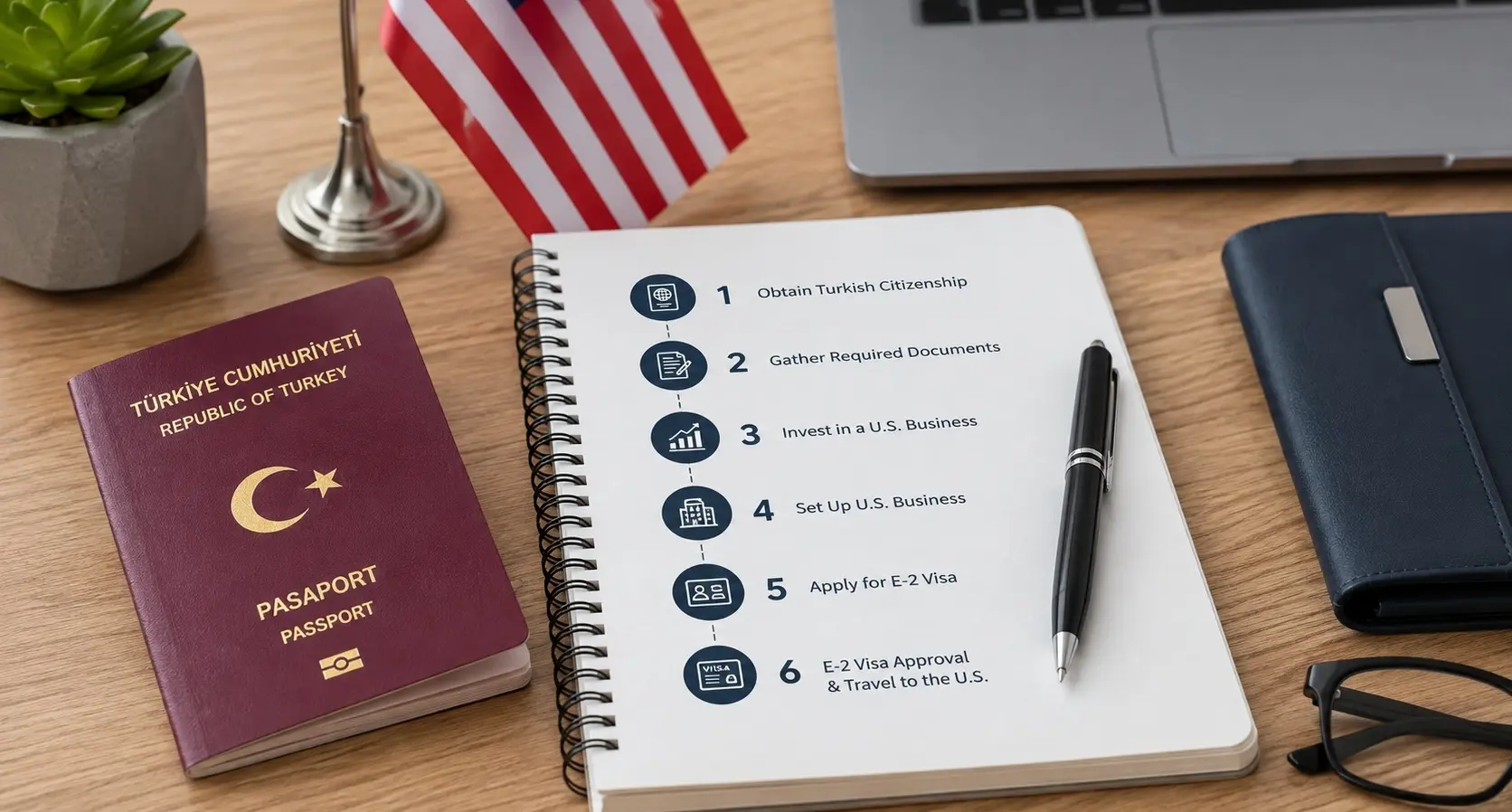
Step-by-Step: Turkey Citizenship to E-2 Visa
Step
Action
Main Evidence or Decision
1
Confirm the strategy
Check existing nationalities, US admissibility, family timing, and the domicile rule before investing
2
Select a Turkish route
Property applicants commonly buy eligible real estate worth at least $400,000 USD with a three-year sale restriction
3
Complete Turkish procedures
Obtain valuation and eligibility documents, register the investment, and submit the citizenship application
4
Receive citizenship
Obtain Turkish identity documents and passports. Citizenship does not itself approve an E-2 visa
5
Establish domicile
Live in Turkey continuously for at least three years and retain evidence that it is the genuine principal home
6
Choose a US enterprise
Create a company, purchase an operating business, or acquire a suitable franchise
7
Commit the investment
Put funds at risk and prepare source records, contracts, accounts, forecasts, staffing plans, and operating evidence
8
Apply for E-2
Complete Form DS-160, follow embassy instructions, pay the fee, and attend the interview
9
Enter and operate
Request admission, direct the business, and preserve evidence for renewals
The Turkish stage requires property and immigration due diligence. The asset must qualify under current rules, its valuation must support the threshold, and ownership, payment, and Title Deed details must be correctly structured.
The US business can be researched during the domicile period. An E-2 enterprise normally needs committed funds and readiness to operate when adjudicated. Committing too early may create unnecessary commercial risk.
What Makes a US Investment Qualify?
There is no official universal minimum such as $100,000 USD or $200,000 USD. “Substantial” is assessed against the total cost of the enterprise. A lower-cost service company may require a very high proportion of its cost to be invested, while a larger acquisition is assessed differently. A credible E-2 case normally demonstrates:
- Lawful Funds: Money can be traced from its legitimate source through every transfer into the enterprise.
- Capital at Risk: Funds are exposed to commercial gain or loss, rather than held personally.
- A Real Enterprise: The company is active or imminently operational, with appropriate premises, contracts, equipment, licences, staff, or customers.
- Substantiality: The amount is sufficient compared with the full cost of creating or buying the business.
- Control: The investor owns at least 50% or otherwise has authority to direct operations.
- Non-marginality: The company can exceed a basic family living or make a significant economic contribution.
- Intent to Depart: The applicant accepts E-2 status is temporary and will leave when it ends.
Family Rights, Renewals and Long-term Planning
The investor’s spouse and unmarried children under 21 may apply as dependants, even when they hold non-treaty passports. A qualifying E-2 spouse is generally employment-authorised through status and may work outside the E-2 enterprise.
Children may attend school but lack the same general work right. They cease qualifying as E-2 children at 21, so families with teenagers should plan early for university, independent status, or departure.
E-2 status can be renewed repeatedly in two-year increments where the enterprise remains eligible and the investor continues directing it. Turkey’s reciprocity schedule permits multiple-entry visas valid for up to 60 months, although every renewal remains discretionary.
The E-2 does not automatically convert into permanent residence. A later immigrant route, such as family sponsorship, an employment category, or EB-5, requires independent eligibility and careful planning.
Relevant E-2 Visa Statistics
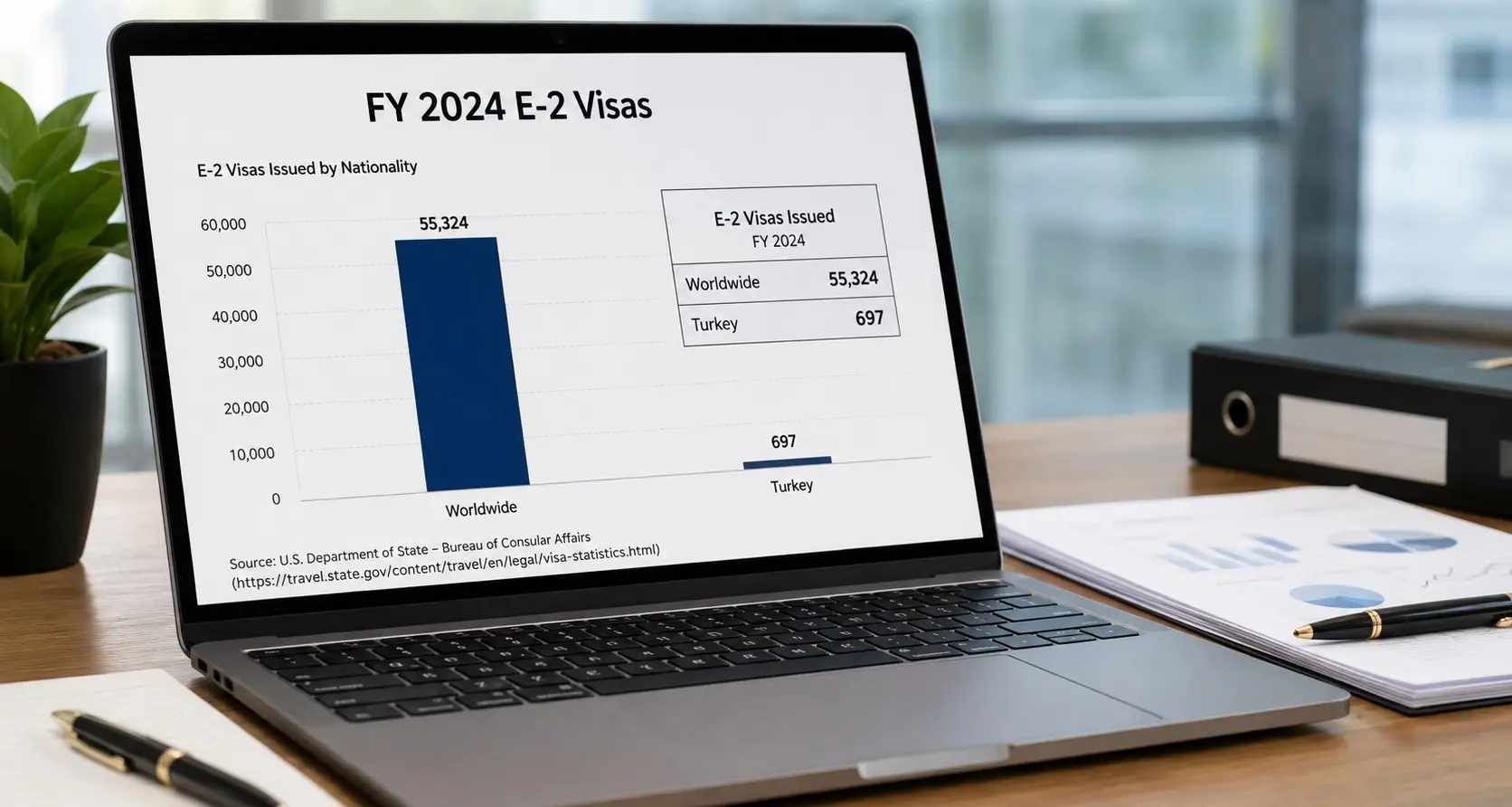
US Department of State figures show 55,324 E-2 visas were issued worldwide during the 2024 fiscal year. Turkish nationals received 697, compared with 17,272 issued across Europe.
The figures demonstrate established use, but do not reveal how many Turkish applicants obtained nationality through investment. The total includes citizens by birth, descent, naturalisation, and investment, plus qualifying employees and family members issued within the classification.
Statistics are not approval forecasts. Every application is assessed individually, with nationality, domicile, source of funds, ownership, business viability, experience, and interview evidence affecting the result.
Planning the Route with Property Turkey
Using Turkish citizenship for a future E-2 application is a multi-year mobility and business strategy, not a rapid visa product. Strong candidates choose Turkish investments they value, establish real lives in Turkey, and prepare their American enterprises with equal care.
Property Turkey helps international buyers identify suitable real estate, understand citizenship-linked purchase requirements, and complete acquisitions with experienced legal and property professionals. Speak with our team to explore eligible opportunities and build the Turkish stage of your wider global investment plan.
FAQs: Turkish Citizenship to E-2 Visa
Q: Can an Indian or mainland Chinese citizen use Turkish citizenship for an E-2 visa?
A: Potentially. The person must become Turkish, satisfy the three-year continuous domicile rule for investment-acquired nationality, and independently meet every E-2 business, investment, and admissibility condition.
Q: How much must be invested in the US?
A: There is no fixed statutory figure. Capital must be substantial relative to the enterprise’s total cost, enough to make it operational and genuinely at risk. A credible, properly funded business is more important than an unofficial minimum.
Q: Can the E-2 investment be a house or apartment?
A: A personal or passively held property is not a qualifying enterprise. An active development, management, or hospitality company may qualify where it has genuine operations, sufficient capital, commercial activity, and active direction.
Q: Does an E-2 visa lead to a green card?
A: Not directly. It is a renewable nonimmigrant classification requiring an intention to depart when status ends. Permanent residence needs a separate legal basis, considered with specialist advice before relocation.
Q: How long can the family live in America?
A: A Turkish E-2 visa may permit multiple entries over 60 months, while each admission is normally up to two years. Continued residence depends on maintaining status, observing I-94 dates, and securing further admissions or extensions.
NOTE: This guide provides general information and is not Turkish or US legal, immigration, tax, or investment advice. Rules, fees, and procedures can change, so every applicant should obtain advice tailored to their circumstances.
Cameron Deggin Founder & CEO, Property Turkey
Cameron Deggin is Founder and CEO of Property Turkey. A former finance professional and FCCA-qualified accountant, he founded the company in 2001 after recognising Turkey’s investment potential. With more than two decades analysing Turkish real estate, Cameron regularly advises international investors and is quoted by media including the Financial Times and BBC.




 By:
By:








 Founder & CEO, Property Turkey

 Bodrum
  4
4  5
5 
















 X
X