Foreign-owned property in Turkey passes to the owner’s heirs under Turkish inheritance law. The owner’s nationality does not remove those rights, and a Turkish home does not become state property simply because its owner was foreign.
The process involves establishing the heirs, calculating their shares, completing the tax declaration, and updating the Title Deed. For owners planning ahead, the priority is to understand who inherits, what a Will can achieve, and which documents their family will need.

Which Law Applies to Property Inheritance in Turkey?
Article 20 of Law No. 5718 distinguishes between inheritance generally and real estate situated in Turkey. Inheritance is generally governed by the deceased’s national law, but Turkish law applies to immovable property in Turkey, including apartments, villas, commercial premises, and land.
An overseas passport, foreign marriage, or Will signed abroad does not displace that rule. A British owner’s Istanbul apartment, for example, is subject to Turkish succession rules even when the owner lived permanently in Britain.
Assets outside Turkey require separate consideration under the applicable rules in those jurisdictions. Families with homes, investments, and bank accounts across several countries should coordinate their estate planning rather than assume every asset follows the same distribution.

Who Inherits a Turkish Property Without a Will?
Turkish statutory succession determines the heirs when there is no effective Will changing the distribution. Descendants come first. Children inherit equally, and the descendants of a child who died before the owner take that child’s place within their family branch.
The surviving spouse inherits alongside the applicable class of relatives. The spouse’s percentage increases when there are no descendants. The following table shows the statutory position before adjustments for debts, matrimonial property claims, or valid testamentary arrangements.
| Surviving Family |
Spouse’s Statutory Share |
Remaining Inheritance |
| Spouse and descendants |
25% |
75% to the descendants |
| Spouse and parents or their descendants |
50% |
50% to the eligible parental branches |
| Spouse and grandparents or their children |
75% |
25% to the eligible relatives |
| Spouse without relatives entitled to inherit alongside them |
100% |
None |
| Children without a surviving spouse |
None |
100% divided equally between children, with representation where applicable |
These proportions follow the statutory succession rules in the Turkish Civil Code.
An unmarried partner has no statutory spouse’s share. A stepchild does not inherit from a stepparent solely because of the marriage. Owners wishing to provide for these family members need deliberate arrangements that respect protected inheritance rights.
Children from an earlier marriage retain their inheritance rights after a parent remarries. A new marriage does not erase that relationship. Owners with blended families should identify every child and the surviving spouse before deciding how to distribute their Turkish home or calculating the portion available under a Will.

Does Joint Ownership Mean the Survivor Gets Everything?
Joint ownership does not automatically transfer the deceased owner’s share to the surviving co-owner. The survivor retains their existing interest, while the deceased’s interest enters the inheritance process.
For Example: Consider a married couple holding equal registered shares in an apartment, with two children. Assuming those shares determine the estate and there are no separate matrimonial claims or Will provisions, the survivor keeps their 50% and inherits 25% of the deceased’s half. The resulting ownership is 62.5% for the surviving spouse and 18.75% for each child. The spouse does not become sole owner simply because the couple purchased the home together.
Matrimonial property rights must be assessed before the final estate is calculated. Registration in one spouse’s name does not settle every financial claim between spouses. Check the Title Deed, acquisition history, and applicable matrimonial regime together.

What Are Reserved Shares Under Turkish Inheritance Law?
Turkish law protects minimum entitlements for specified relatives. These reserved shares limit how much an owner can leave to someone else through a Will or certain lifetime transfers:
- Children and Other Descendants: Their reserved share is half their statutory entitlement. Where children collectively inherit 75% alongside a spouse, their collective reserved share is 37.5% of the estate, allocated between the appropriate descendants.
- Parents: Each surviving parent’s reserved share is one quarter of their statutory entitlement when they qualify as heirs. This protection is calculated from that parent’s inheritance share, not from the entire property value.
- The Surviving Spouse: The spouse’s entire statutory share is protected when inheriting with descendants or the parental class. In other cases, the reserved share is three quarters of the spouse’s statutory entitlement. Siblings have no reserved share.
A Will leaving everything to one beneficiary does not automatically defeat these protections. An heir whose reserved share is infringed can bring a reduction claim. The calculation requires the estate’s assets, liabilities, and relevant lifetime gifts to be assessed together.

Can Foreign Owners Make a Will in Turkey?
Foreign nationals can make a Turkish Will. An official Will prepared before a notary provides a formal record of the owner’s instructions, identity, and execution. Under the Civil Code, an official Will requires two witnesses who satisfy the legal requirements.
Prepare the Title Deed details, beneficiary identities, and intended distribution before the appointment. If the owner does not understand Turkish, arrange the interpreter required for the procedure. Witness eligibility, capacity, and signing formalities must be checked before execution.
A Turkish Will should also be coordinated with existing overseas Wills. A broad revocation clause in a later document can undermine earlier planning. Lawyers handling different parts of the estate should know which assets each document is intended to cover.
A foreign Will is not automatically invalid in Turkey. Article 20 recognises testamentary documents made in a form complying with the deceased’s national law, alongside other applicable formal-validity rules. However, formal validity does not remove Turkish reserved-share protection for Turkish real estate.

Can Gifting a Property Avoid Inheritance Restrictions?
An owner can sell or gift property during their lifetime, subject to legal capacity, transfer formalities, and ownership restrictions. However, a gift is not a guaranteed method of bypassing reserved shares. Transactions falling within the statutory rules remain open to reduction claims.
An apparent sale also needs to reflect the actual transaction. If a family transfer is described as a sale, retain evidence of payment and the commercial basis. Recording a fictitious purchase does not provide dependable inheritance planning.
Lifetime gifts have their own tax treatment, which differs from inheritance. Before transferring ownership, compare the tax cost, protected heirs’ rights, and the owner’s continuing housing needs. Giving away the Title Deed also changes who controls a future sale or mortgage.
Standard gift tax rates are 10% to 30%, compared with 1% to 10% for inheritance. Certain transfers between parents, spouses, and children benefit from half the gift rates, subject to the statutory conditions. These differences deserve calculation before an owner chooses a lifetime transfer.

Which Documents Do Foreign Heirs Need?
Start with the documents establishing death, identity, and family relationships. For a foreign inheritance file, prepare the following for the Turkish lawyer handling the application:
- Death and Identity Records: Obtain the official death certificate, the deceased’s identification records, and each heir’s passport. Resolve differences in names, dates, or transliteration before submitting the documents to the court or arranging translations.
- Family Relationship Records: Provide birth certificates, marriage records, and any divorce, adoption, or name-change decisions needed to establish the family tree. A complete record prevents a previous marriage or missing relative from being overlooked.
- Property and Estate Records: Supply the Title Deed or accurate registry details, available mortgage information, and any Will or overseas probate documents. Include evidence of debts and matrimonial claims affecting the estate’s net value.
- Authority to Act: Where a lawyer represents an heir, prepare a Power of Attorney covering the necessary inheritance, tax, and land registry procedures. Confirm the wording before signing, particularly when the document is issued overseas.
Foreign public documents require the applicable authentication, followed by Turkish translation in the required certified form. Use an apostille where the convention applies, unless an exemption exists. Otherwise, follow the appropriate legalisation procedure. Authentication does not establish the inheritance shares.

How Is the Property Transferred to the Heirs?
Foreign applicants obtain a certificate of inheritance through the Turkish Civil Court of Peace, known as the Sulh Hukuk Mahkemesi. Turkish notaries cannot issue this certificate where the request is made by foreigners. The certificate identifies the recognised heirs and their shares.
An overseas probate grant is not a substitute that the land registry accepts automatically. Article 37 of the Land Registry Law provides for Turkish court-issued certificates or foreign certificates whose conformity with Turkish succession procedures has been confirmed by a Turkish court.
With heirship established, arrange the inheritance tax declaration and the application to register the inherited property. The Title transfer, called intikal, records the inheritance in the land registry. Ownership passes by succession at death; registration updates the official property record.
Check mortgages, attachments, usufruct rights, and other registered restrictions before deciding whether to retain or sell the home. Buildings subject to compulsory earthquake insurance also require the appropriate DASK policy for the registry procedure.
Heirs living abroad can appoint a lawyer under a properly prepared Power of Attorney. Collect the records first and confirm the application requirements before arranging travel. There is no fixed completion period covering court work, foreign documentation, taxation, and registration.

How Much Is Inheritance Tax in Turkey?
Turkish inheritance and transfer tax applies to inherited assets situated in Turkey, including property owned by foreigners. The standard inheritance rates are progressive, ranging from 1% to 10%. Each heir’s taxable acquisition is assessed after the applicable exemptions and deductions.
For 2026, the exemption for each qualifying descendant and spouse is TRY 2,907,136. Where the deceased leaves no descendants, the spouse’s exemption is TRY 5,817,845. This higher allowance is not limited to cases where the spouse is the only heir.
The standard 2026 inheritance tax bands are:
| Taxable Amount Inherited by Each Heir |
Rate |
| First TRY 3,000,000 |
1% |
| Next TRY 7,000,000 |
3% |
| Next TRY 15,000,000 |
5% |
| Next TRY 30,000,000 |
7% |
| Amount above TRY 55,000,000 |
10% |
For Example: A taxable inheritance of TRY 4 million after exemptions and deductions produces TRY 60,000 in standard inheritance tax: TRY 30,000 on the first TRY 3 million and TRY 30,000 on the remaining TRY 1 million.
Real estate is declared using the statutory property-tax valuation basis. Obtain the relevant municipal value and establish deductible liabilities before calculating the return.
The New 1% Rate for Qualifying Tax Residents
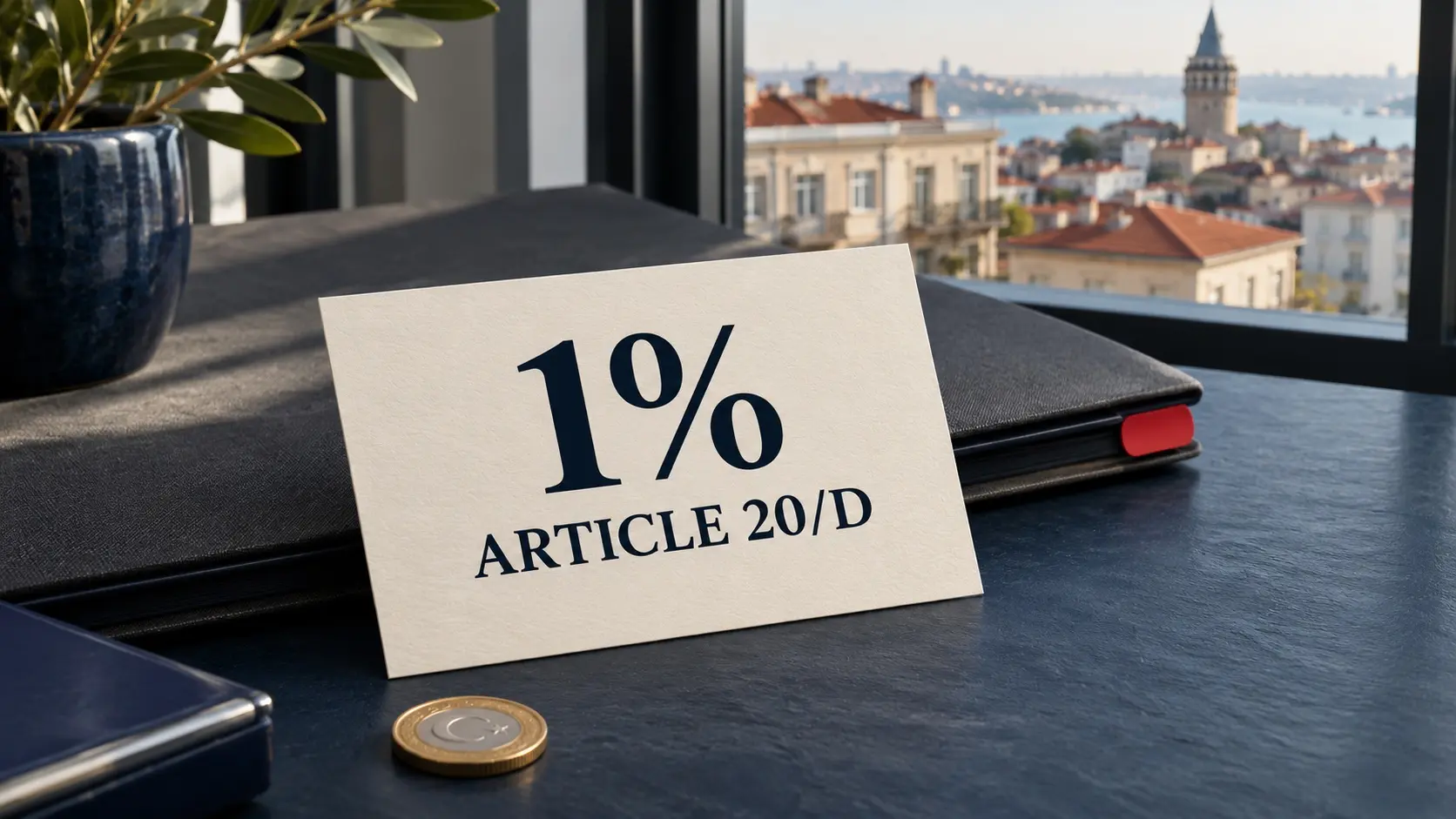
A 2026 amendment introduced a specific inheritance tax provision for individuals benefiting from the foreign-income exemption under Income Tax Law Article 20/D. Inheritances from these individuals during the applicable exemption period are taxed at 1% under the new rule.
The provision is tied to the deceased’s qualifying status. It does not apply to every foreign property owner, every Turkish citizen, or every person holding a Residence Permit. Buying a property does not establish entitlement to this treatment.
Article 20/D provides a 20-year foreign-income exemption for qualifying residents without Turkish domicile or tax liability during the preceding three calendar years, subject to specified investment-income exceptions. Owners considering this regime should have eligibility documented and inheritance tax position reviewed alongside the estate plan.
Filing Deadlines and Paying the Tax
An inheritance tax declaration is required even when the inherited amount falls below the exemption. Filing deadlines depend on where the death occurred and where the heir is located. They are calculated from the death, rather than the eventual Title registration.
Where death occurs in Turkey, the deadline is four months for heirs in Turkey and six months for heirs abroad. Where death occurs abroad, heirs in Turkey have six months, heirs in the same foreign country have four months, and heirs in another foreign country have eight months.
Assessed inheritance tax is payable over three years in six payments, falling in May and November. Registration of the inheritance does not require waiting for the tax assessment, but subsequent selling of the property requires the inheritance tax position to be cleared.
Other expenses include court costs, translations, authentication, legal representation, and registry service charges. These are separate from inheritance tax. Obtain an itemised estimate based on the actual documents and work required.

Keeping or Selling an Inherited Property
Foreign heirs must distinguish their inheritance entitlement from permission to retain the property. Nationality and property restrictions still require assessment. Where an heir cannot legally retain the inherited real estate, the statutory disposal procedure applies, and the heir receives the resulting proceeds.
Where several heirs inherit together, their rights must be addressed before a sale of the property. One heir cannot sell everyone else’s interest. Agree whether the property will be retained, sold, or allocated through a formal division of the estate.
The estate also includes liabilities. Turkish law provides a three-month period for rejecting an inheritance, with the starting date determined by the heir’s circumstances. Obtain advice promptly where debts are substantial; waiting for the property transfer is not a substitute for addressing that deadline.

Planning Ahead with Property Turkey
Keep an accessible estate file containing the Title Deed details, family records, Will information, and professional contacts. Review it after marriage, divorce, a birth, or a new property purchase. Tell the intended heirs where the original documents are held.
Property Turkey can help owners review their property plans and coordinate introductions to qualified legal and tax advisers. Contact us to discuss your Turkish property, ownership arrangements, and the preparations needed for your family’s future inheritance.

FAQs: Inheriting Property in Turkey
Q: Can foreigners inherit property in Turkey?
A: Yes. Foreign nationals have inheritance rights over Turkish property. Heirship must be established through documents accepted in Turkey, and the heir’s right to retain the particular property must be checked against nationality and ownership restrictions.
Q: Does a spouse automatically inherit the whole property?
A: No. A spouse inheriting alongside descendants receives 25% of the deceased’s estate under statutory succession. Existing ownership and matrimonial property claims are assessed separately. Joint ownership does not automatically make the survivor the sole owner.
Q: Is a foreign Will valid for Turkish property?
A: A Will meeting the applicable formal-validity rules, including the deceased’s national-law requirements, is recognised in principle. Turkish procedures still apply to its use, and reserved-share protections govern testamentary arrangements concerning real estate situated in Turkey.
Q: Do foreign heirs need a Turkish certificate of inheritance?
A: The land registry requires a Turkish court-issued inheritance certificate or a qualifying foreign certificate confirmed by a Turkish court. A foreign applicant must use the court procedure; a Turkish notary cannot issue their inheritance certificate.
Q: Is inherited Turkish property tax-free for foreigners?
A: No. Turkish inheritance tax applies to property situated in Turkey. Exemptions depend on the heir’s relationship and the applicable year. Standard rates range from 1% to 10%, with a separate rule for qualifying Article 20/D beneficiaries.
Q: Can heirs handle the process without travelling to Turkey?
A: Heirs can authorise a Turkish lawyer through a suitable Power of Attorney. Overseas documents require the correct authentication and translation. Confirm the authority needed for court proceedings, tax declarations, registration, and any proposed sale before signing.

Nezir Can  Operations Manager
Nezir 'Nez' Can is Operations Manager at Property Turkey and a contributor on Turkish culture, lifestyle, and everyday life across the country. Since joining the company, he has helped international readers better understand what it is like to live, work, and settle in Turkey.
View full author profile →




 By:

 Istanbul
 3
 3














 X